Flashlight Reflectors Explained: How Optics Shape the Beam
When most people compare flashlights, they focus on specifications like lumens, brightness, and battery life. While these numbers are important, they don’t tell the whole story about how a flashlight performs in the real world.
One of the most important components inside a flashlight is the reflector. The reflector works together with the LED emitter to shape and control the beam of light. In fact, two flashlights with the same LED and lumen output can produce very different beams depending on their reflector design.
In this guide, we’ll explain how flashlight reflectors work, the different types of reflector designs, and how optics influence beam distance, brightness distribution, and overall flashlight performance. If you’re looking for powerful lighting tools engineered with precision optics and advanced LED technology, you can explore professional options in the Speras LED Flashlights collection.
What Is a Flashlight Reflector?
A flashlight reflector is the polished metal surface inside the head of the flashlight that surrounds the LED emitter. Its job is to collect the light produced by the LED and direct it forward into a controlled beam.
Without a reflector, light from the LED would spread in all directions, creating weak and unfocused illumination. The reflector captures this light and redirects it toward the front of the flashlight, producing a usable beam.
Reflectors are typically made from highly polished aluminum and are carefully shaped to control how the beam forms as it exits the flashlight.
The geometry of the reflector determines:
- how wide the beam is
- how far the light travels
- how smooth the beam appears
Because of this, reflector design plays a major role in flashlight performance.
How Reflectors Shape the Flashlight Beam
The LED emitter produces light in all directions. The reflector sits around the emitter and redirects the light forward by reflecting it off its curved surface.
The shape of the reflector controls how the light rays converge and form the beam.
A typical flashlight beam consists of two main parts:
Hotspot
The hotspot is the bright central area of the beam where the light is most concentrated. This portion of the beam provides the longest visible distance.
Spill
The spill is the softer light surrounding the hotspot. It illuminates the area around the user and helps improve situational awareness.
Reflector design determines how these two parts of the beam interact. Some reflectors emphasize long-distance performance, while others produce wider beams that illuminate larger areas.
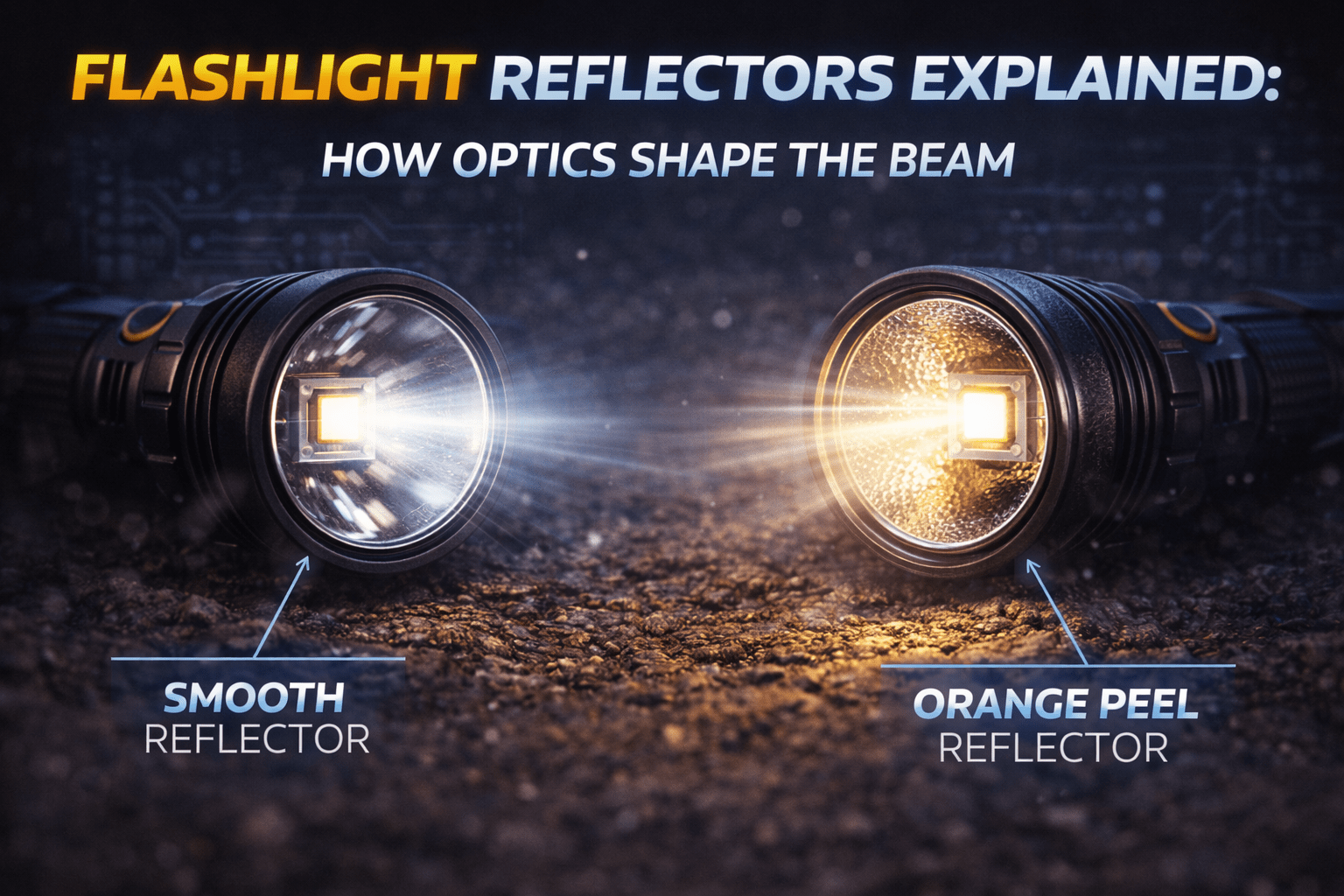
Smooth vs Orange Peel Reflectors
Flashlight reflectors are typically manufactured with either a smooth surface or a textured surface known as an orange peel reflector.
These two designs produce noticeably different beam characteristics.
Smooth Reflectors
Smooth reflectors have a highly polished, mirror-like surface that reflects light with minimal diffusion.
Advantages of smooth reflectors include:
- higher beam intensity
- longer beam distance
- more defined hotspot
Because of these characteristics, smooth reflectors are often used in flashlights designed for long-distance illumination or high-candela performance.
However, smooth reflectors can sometimes produce visible beam artifacts or rings due to the highly focused reflection.
Orange Peel Reflectors
Orange peel reflectors have a slightly textured surface that resembles the skin of an orange. This texture diffuses the reflected light slightly, smoothing out the beam.
Advantages of orange peel reflectors include:
- smoother beam pattern
- reduced beam artifacts
- more balanced illumination
Because the light is slightly diffused, these reflectors often produce a softer hotspot and broader spill.
Orange peel reflectors are commonly used in general-purpose flashlights, where a balanced beam is more useful than extreme distance.
Reflector Depth and Beam Distance
Another major factor affecting beam performance is reflector depth.
The depth of the reflector influences how tightly the light is focused when it leaves the flashlight.
Deep Reflectors
Deep reflectors focus the light more tightly, producing:
- higher candela
- longer beam distance
- stronger hotspot
Flashlights designed for long-range illumination often use deep reflectors to concentrate the beam.
These designs are common in flashlights used for:
- hunting
- search and rescue
- security patrol
- outdoor exploration
Shallow Reflectors
Shallow reflectors spread light over a wider area, creating:
- broader beams
- more spill illumination
- shorter beam distance
This design is ideal for situations where wide visibility is more important than long distance.
Shallow reflector designs are often used in flashlights intended for:
- camping
- hiking
- indoor work
- everyday carry
Reflectors vs TIR Optics
While traditional reflectors are still widely used, many modern flashlights now use TIR optics, which stands for Total Internal Reflection.
TIR optics use a specially designed lens instead of a reflective surface to control the beam.
Reflector-Based Flashlights
Reflector systems:
- use polished metal surfaces
- produce strong hotspots and defined beams
- are commonly used in high-performance flashlights
Reflectors are especially effective for long-distance beam performance.
TIR Optics
TIR lenses combine reflection and refraction to shape the beam.
Advantages of TIR optics include:
- smoother beam patterns
- compact design
- efficient light control
These optics are often used in smaller flashlights and headlamps where a balanced beam is preferred.
Both reflector and TIR systems have advantages, and manufacturers choose the design that best fits the intended purpose of the flashlight.
Choosing the Right Beam Pattern
Different activities require different beam characteristics. Understanding reflector design can help you choose a flashlight that performs best for your needs.
| Activity | Ideal Beam Type |
|---|---|
| Camping | wide flood beam |
| Hiking | balanced beam |
| Home use | wide illumination |
| Security patrol | long-distance beam |
| Search operations | high-intensity throw |
For everyday use, many people prefer flashlights that provide a balanced beam, offering both useful beam distance and sufficient spill light to illuminate nearby surroundings.
Why Optics Matter in High-Performance Flashlights
High-performance flashlights are carefully engineered to combine several key components:
- LED emitter
- reflector or optical system
- driver electronics
- battery system
The reflector plays a critical role in this system by ensuring that the light produced by the LED is shaped into a useful beam.
Advanced reflector designs allow modern flashlights to produce strong beam distance, smooth illumination, and efficient light distribution.
Without carefully engineered optics, even the brightest LED would struggle to deliver effective illumination.
Final Thoughts
Flashlight reflectors are one of the most important yet often overlooked components in flashlight design. While specifications like lumens and candela often receive the most attention, the reflector is responsible for shaping how that light is projected into the environment.
Different reflector designs produce different beam patterns, allowing flashlights to be optimized for long-distance illumination, wide-area lighting, or balanced performance.
By understanding how flashlight optics work, users can choose lighting equipment that better matches their needs and provides reliable performance in real-world situations.
If you’re looking for high-performance lighting tools engineered with advanced optics and powerful LEDs, explore the Speras LED Flashlights collection designed to deliver dependable illumination in demanding environments.