Flashlight Drivers Explained: How Modern Torches Control Power and Brightness
Modern flashlights are far more advanced than the simple battery-powered torches many people grew up using. Today’s high-performance flashlights can produce thousands of lumens, offer multiple brightness modes, and maintain consistent illumination for extended periods.
Behind this performance lies an often-overlooked component: the flashlight driver.
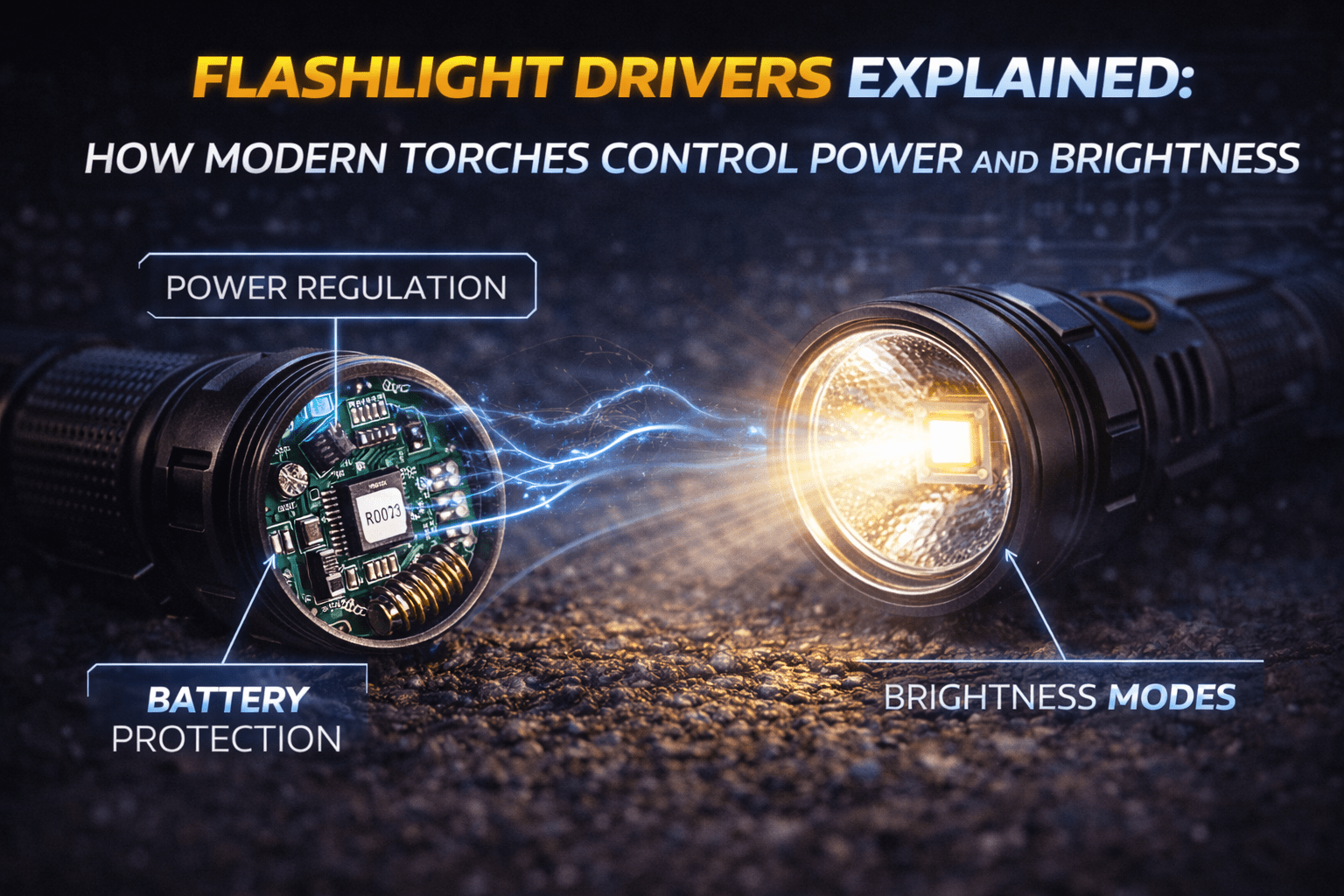
While the LED emitter produces the light and the battery provides the power, the driver is the electronic brain of the flashlight. It regulates power, controls brightness modes, protects the LED and battery, and ensures the flashlight operates efficiently and safely.
In this guide, we’ll explain what flashlight drivers are, how they work, and why they are essential for modern high-performance lighting tools. If you’re looking for powerful lighting equipment designed with advanced electronics and optimized performance, you can explore professional options in the Speras LED Flashlights collection.
What Is a Flashlight Driver?
A flashlight driver is a small electronic circuit located inside the flashlight head. Its job is to regulate the electrical power flowing from the battery to the LED emitter.
LEDs require very precise electrical conditions to function properly. Unlike traditional incandescent bulbs, LEDs cannot simply be connected directly to a battery without regulation.
Without a driver circuit, several problems could occur:
- the LED could receive too much current and burn out
- brightness would fluctuate as the battery drains
- the flashlight could overheat
- battery life would be significantly reduced
The flashlight driver solves these problems by controlling how much electrical current reaches the LED at any given moment.
This allows the flashlight to produce stable brightness levels and efficient power usage.
How Flashlight Drivers Control Brightness Modes
One of the most noticeable features of modern flashlights is the ability to switch between different brightness levels. Many flashlights offer multiple modes, allowing users to adjust illumination depending on the situation.
Common flashlight modes include:
- Low mode – maximum battery life with minimal brightness
- Medium mode – balanced brightness and runtime
- High mode – strong illumination for demanding situations
- Turbo mode – maximum brightness for short bursts
- Strobe mode – rapid flashing used in emergency or tactical situations
These brightness levels are controlled entirely by the flashlight driver.
The driver adjusts the electrical current flowing to the LED, which determines how much light the LED produces.
For example:
- Low mode may supply a small amount of current
- High mode supplies significantly more power
- Turbo mode pushes the LED close to its maximum output
By controlling these power levels, the driver allows the flashlight to adapt to different environments and tasks.
Constant Current vs Direct Drive
Not all flashlights regulate power in the same way. Two common approaches to powering LED flashlights are constant current drivers and direct drive systems.
Understanding the difference between these systems helps explain why driver design plays such an important role in flashlight performance.
Constant Current Drivers
A constant current driver maintains a stable electrical current flowing to the LED regardless of battery voltage changes.
This means the flashlight can maintain consistent brightness even as the battery slowly discharges.
Advantages of constant current drivers include:
- stable brightness output
- improved efficiency
- longer LED lifespan
- predictable performance
Most high-quality flashlights use constant current drivers because they provide reliable and controlled illumination.
Direct Drive Systems
In a direct drive flashlight, the LED is powered more directly from the battery with minimal electronic regulation.
As the battery voltage drops over time, brightness gradually decreases.
Direct drive systems can sometimes deliver very high brightness levels initially, but they tend to lose brightness as the battery drains.
Because of this, direct drive designs are less efficient and less consistent compared to regulated driver circuits.
Thermal Protection: Preventing Overheating
High-performance flashlights can produce extremely high brightness levels, especially when operating in turbo mode. This intense output generates heat inside the flashlight head.
If heat builds up too quickly, it can damage internal components or shorten the lifespan of the LED.
Modern flashlight drivers include thermal protection systems that monitor the flashlight’s temperature.
When the temperature reaches a certain threshold, the driver automatically reduces the brightness level to prevent overheating.
This process is sometimes called thermal step-down.
Thermal protection ensures that the flashlight continues operating safely even when producing high levels of light.
Battery Protection and Power Efficiency
Another critical role of the flashlight driver is protecting the battery and managing energy usage efficiently.
Rechargeable lithium-ion batteries used in modern flashlights are powerful but must be carefully controlled to operate safely.
Driver circuits help protect batteries from several potential issues.
Over-Discharge Protection
Lithium-ion batteries can be damaged if they are discharged below safe voltage levels. The driver monitors battery voltage and reduces output or shuts the flashlight off before the battery becomes over-discharged.
Voltage Regulation
As batteries drain, their voltage decreases. The driver compensates for this by regulating the current supplied to the LED.
This allows the flashlight to maintain stable brightness over time.
Efficient Power Usage
Advanced driver circuits convert electrical energy more efficiently, reducing wasted energy and improving overall runtime.
Efficient power regulation means users get more usable light from each battery charge.
Why Driver Quality Matters
Many people compare flashlights primarily by looking at brightness specifications such as lumens. However, the quality of the driver electronics plays an equally important role in overall performance.
A well-designed driver provides several advantages:
- consistent brightness levels
- longer battery runtime
- improved LED lifespan
- safer operation
- efficient power management
Without a high-quality driver circuit, even the most powerful LED emitter cannot perform at its best.
In many ways, the driver acts as the control system that brings together the battery, LED emitter, and optics into a balanced lighting system.
The Role of Drivers in Modern Flashlight Design
Modern flashlights are complex electronic devices designed to deliver powerful illumination in a compact package.
Several key components must work together to achieve this performance:
- LED emitter – produces the light
- reflector or optics – shapes the beam
- battery – provides power
- driver circuit – regulates power and controls brightness
The driver acts as the bridge between the battery and LED, ensuring that power is delivered safely and efficiently.
Advances in driver technology have made it possible for modern flashlights to deliver extremely high brightness levels while maintaining reliable performance and long runtime.
Final Thoughts
Flashlight drivers are one of the most important components inside modern LED flashlights. While they often receive less attention than specifications like lumens or beam distance, they play a crucial role in regulating power, controlling brightness modes, and protecting internal components.
By carefully managing electrical current, the driver ensures that the LED emitter operates efficiently while maintaining stable brightness and safe operating temperatures.
Understanding how flashlight drivers work helps explain why some flashlights deliver superior performance and reliability compared to others.
If you’re looking for powerful lighting tools engineered with advanced electronics, efficient LED systems, and precision optics, explore the Speras LED Flashlights collection designed for demanding environments and real-world performance.