Load-Shedding Survival: Creating the Ultimate Strategic Home Lighting Plan
When the grid drops, the vast majority of South Africans rely on a haphazard collection of bedside torches and whatever battery-powered lanterns they remembered to charge. In my experience auditing technical security and automation systems—a discipline rooted in methodologies my family has developed since 1984—this ad-hoc approach is not just inconvenient; it is a critical security vulnerability.
Surviving Stage 4 or Stage 6 load-shedding requires moving beyond the “buy a torch” mentality. It demands a technical, zonal approach to illumination. Below, I have outlined the core pillars of a strategic home lighting plan, designed to optimise both your psychological comfort and your physical security.
1. The Lighting Hierarchy (The Core Strategy)
A common mistake is treating all light as equal. A robust system requires a tiered matrix, separating illumination by its specific function.
- Ambient/Low-Level Lighting: The goal here is to reduce eye strain, prevent accidents, and maintain a “normal” home atmosphere to reduce anxiety. We achieve this with soft, diffused lanterns or low-wattage LED strips. Crucially, look for units with a high CRI (Colour Rendering Index) of 80+, which prevents that harsh, clinical blue hue that makes a living room feel like a hospital ward.
- Task Lighting: This is targeted illumination for working, preparing food, or detailed reading. Headlamps are vastly superior to handheld torches here, as they free up your hands. If you are examining fine details, documents, or valuable materials and gemstones, a focused, high-CRI desk lamp driven by a dedicated power bank is essential.
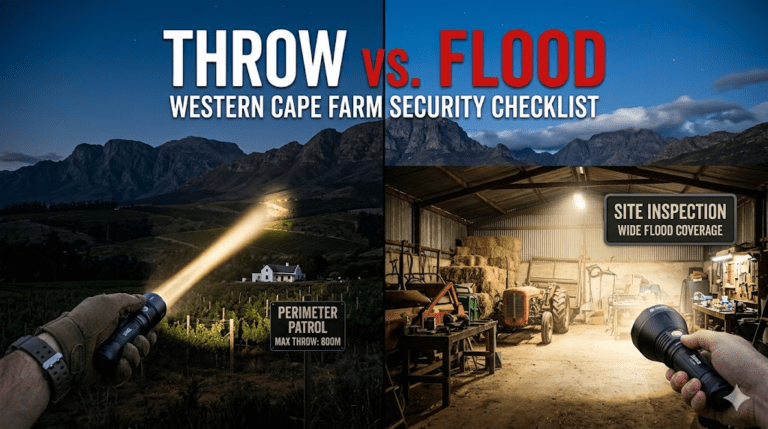
- Tactical/Security Lighting: This is not for reading; it is for threat identification. You require a high-lumen (1000+), high-candela torch with a substantial throw distance. The beam must be concentrated enough to punch through the darkness to the perimeter wall without illuminating the immediate area around you.
2. Room-by-Room Breakdown
Different zones in your home dictate entirely different lighting protocols.
The Kitchen/Living Area (The Social Hub)
This area requires wide-angle, diffused lighting. A central, 360-degree lantern placed on a high surface or suspended from the ceiling is ideal. The objective is to flood the space evenly, allowing family members to interact naturally without shining beams into one another’s eyes.
Bathrooms and Passageways (The Fail-Safes)
These are high-risk zones for slip-and-fall injuries. Relying on someone to carry a torch to the bathroom is a flawed system. Passageways and bathrooms must feature permanent, fail-safe solutions—specifically, plug-in emergency LEDs that remain in the wall socket and trigger automatically the millisecond the grid power cuts.
The Perimeter
Using a standard, wide-beam camping lantern to check a noise in the garden is a massive security liability. A lantern illuminates you just as much as your surroundings, destroying your natural night vision and highlighting you as a target against the dark backdrop of your home. Perimeter checks must only be conducted with tactical, high-throw torches.
3. Power Source Redundancy
During severe load-shedding schedules, the rapid cycling between power and blackouts creates “recharge fatigue.” Relying on a single battery chemistry will eventually leave you in the dark.
- Lithium Iron Phosphate (LiFePO4): If you are investing in portable power stations or fixed backup solutions, LiFePO4 is the non-negotiable standard. Unlike traditional Lithium-ion (Li-ion) or sealed lead-acid batteries, LiFePO4 offers thousands of charge cycles and is highly resistant to degradation from being constantly drained and rapidly recharged.
- Integrated Solar Systems: Small, standalone solar-charged lanterns are excellent secondary backups. Leave them on windowsills during the day to ensure you always have a baseline of light that exists entirely off the grid.
- Primary Cells (Traditional Batteries): Always maintain a tactical torch that runs on high-quality primary cells (like CR123A batteries). These have a shelf life of up to 10 years and serve as your ultimate failsafe when every rechargeable unit in the house has succumbed to grid failure.
4. The “Security Shadow” Concept
How you deploy your lighting determines how vulnerable you appear from the street. The concept of the “Security Shadow” involves lighting the interior of your home without broadcasting your exact position to outside observers.
- Avoid Back-Lighting: Never stand between a bright indoor light source and an open window. This creates a perfect silhouette for anyone observing from the dark outside.
- Angle of Incidence: Position your ambient lighting lower to the ground or angled slightly upward against solid interior walls. This diffuses the light inside the room while minimising the direct glare visible through windows.
- Curtain Discipline: If you must use high-lumen task lighting in a room facing the street, draw heavy, opaque curtains before the light is engaged.
The 15-Minute Pre-Flight Checklist
When the load-shedding application notifies you of an impending cut, use the final 15 minutes of grid power to execute this protocol:
- Verify the Fail-Safes: Ensure all plug-in emergency lights in passageways are securely in their sockets and switched on at the wall.
- Stage the Tactical Gear: Place high-throw security torches in designated, easily accessible locations (e.g., bedside tables, next to the primary safe, by the back door).
- Engage the Social Hub: Position the primary high-CRI lanterns in the kitchen and living areas, ready to be switched on.
- Device Triage: Move all mobile phones, radios, and critical work laptops to their dedicated power banks or UPS connections to top off their final percentages.
- Establish the Shadow: Close street-facing curtains and blinds to secure your visual perimeter before the external streetlights fail.