Jargon Buster: Understanding IP Ratings, ANSI Standards, and CRI in the Field
Picture this: You are patrolling a perimeter fence when a sudden, violent Highveld thunderstorm drops out of nowhere. Or perhaps you are inspecting a pump station near a muddy farm dam, and your flashlight slips from your wet hands into the water. You quickly fish it out, press the tail switch, and… nothing. Just a flicker and then darkness.
You are left standing in the dark, wondering what went wrong. After all, the box boldly claimed it was “water-resistant” and “ultra-durable.”
Here is the harsh reality of the tactical gear industry: marketing adjectives mean absolutely nothing. Anyone can print “Military Grade” or “100,000 Lumens” on a cardboard box. When your life, your property, or your hunt depends on your equipment, the only things that matter are standardized, independent testing metrics.
If you are tired of gambling your money on hardware-store toys that fail in the bushveld, you need to understand the science of illumination. Let’s break down the jargon.
Demystifying the Flashlight IP Ratings Meaning
When evaluating weatherproofing, the only metric you should trust is the IP (Ingress Protection) rating. The flashlight IP ratings meaning is often misunderstood, but it is actually a very simple, standardized two-digit code that tells you exactly what a piece of equipment can survive.
The code is broken down into two parts: IP[Solid Ingress][Liquid Ingress].
- The First Digit (Solids/Dust): This is rated on a scale of 0 to 6. It measures protection against solid objects, from large tools down to microscopic dust.
- The Second Digit (Liquids/Water): This is rated on a scale of 0 to 8 (and sometimes 9K). It measures protection against water.
Why the “6” is Just as Important as the “8”
Many buyers only look for the water rating, opting for an IPX4 torch (the “X” means it wasn’t tested for dust, and the 4 means it can handle a light drizzle). This is a massive mistake for the South African context.
If you operate in the dusty Karoo, or your bakkie kicks up clouds of fine, powdery sand on dirt roads, dust ingress will destroy your flashlight’s internal tail-switch contacts long before water does.
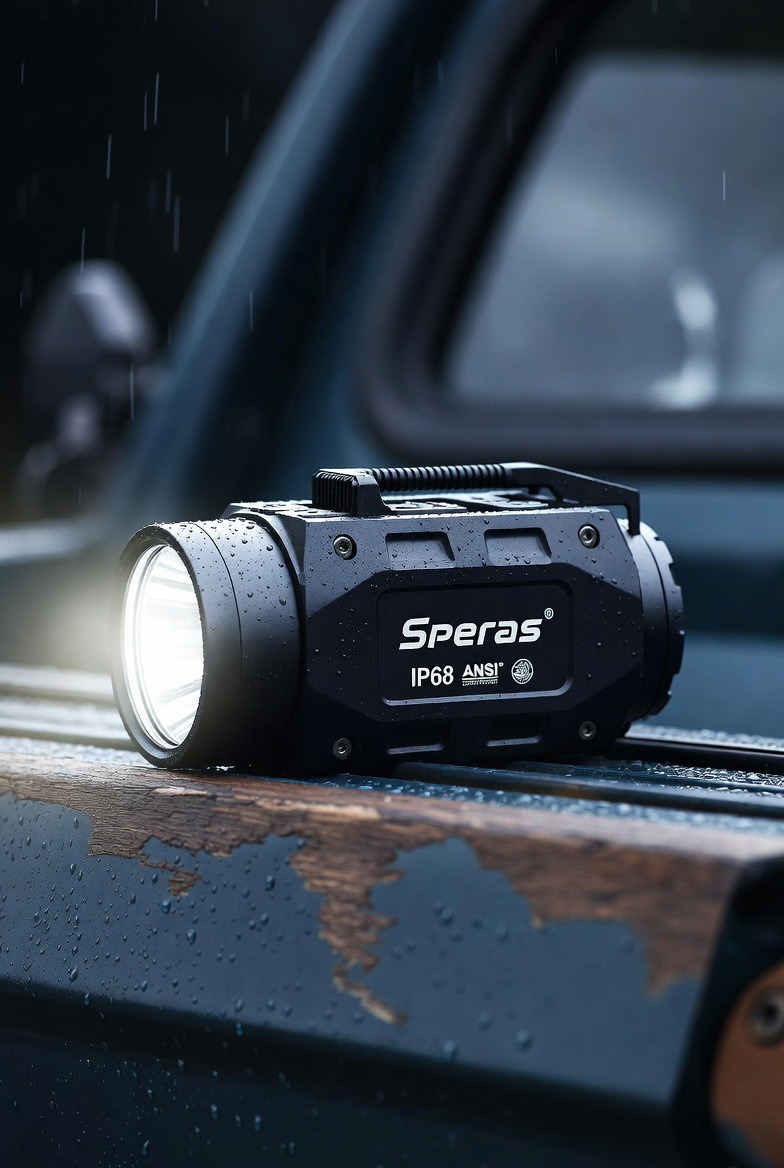
A true duty-grade flashlight will carry an IP68 rating.
- The 6 means it is completely, 100% dust-tight. Microscopic particles cannot penetrate the housing.
- The 8 means it can survive continuous submersion in water beyond 1 meter (usually specified by the manufacturer, like 2 meters for 30 minutes).
If a torch is IP68 rated, it means dropping it into a farm dam or using it through a torrential downpour will not compromise its performance.
The Truth About Tactical Torch ANSI Standards
Before 2009, flashlight manufacturers could make up whatever lumen or distance numbers they wanted. To stop this wild west of false advertising, the American National Standards Institute (ANSI) developed the FL1 Standard.
If a manufacturer is honest, their packaging will display the official ANSI FL1 icons. Understanding tactical torch ANSI standards is the ultimate shield against cheap knock-offs. Two of the most critical ANSI tests are:
1. Impact Resistance (The Drop Test)
A torch is dropped six times from a specified height (e.g., 1.5 meters or 2 meters) onto a solid concrete surface. To pass, the flashlight must remain fully functional, with no cracks in the lens or body. If a light does not have an ANSI impact rating, the violent recoil of a rifle or a simple drop from your waist onto a rocky path could instantly sever its internal soldering.
2. Beam Distance (Standardized Throw)
Manufacturers used to calculate distance by simply measuring how far the light physically traveled, even if it was just a microscopic photon. The ANSI standard changed this. Beam distance is now strictly measured as the distance from the flashlight to the point where the beam’s intensity drops to 0.25 lux (roughly the equivalent of the light provided by a full moon on a clear night). This gives you a realistic, usable measurement of how far you can actually see a target.
Buying a flashlight without ANSI FL1 certification is essentially paying for a marketer’s imagination.
Seeing the Truth: What is a High CRI Flashlight?
While lumens measure total light output and candela measures the distance of the beam, CRI measures the quality of the light itself.
So, what is high CRI flashlight technology, and why do professionals demand it?
CRI stands for Color Rendering Index. It is measured on a scale of 0 to 100, with 100 being natural, direct sunlight.
Standard, cheap LED flashlights usually hover around a CRI of 65 or 70. They emit a harsh, bluish-white light. This washes out colors, flattens textures, and makes everything look like a grey, indistinguishable blob. High CRI flashlights use specialized LEDs that score 90 or above, revealing the true, vibrant colors of whatever you are illuminating.
South African Field Applications for High CRI
- The Blood Trail: You are a hunter tracking a wounded animal in thick bush at dusk. Under a cheap, low-CRI blue light, a drop of red blood on a brown leaf looks black or dark grey, blending in perfectly with the shadows. Under a High CRI (90+) flashlight, that red blood distinctly pops against the earth tones, making tracking significantly faster and more ethical.
- Suspect Identification: You are a plaaswag member shining a light on a trespasser fleeing into the tree line. Under a low-CRI light, their jacket looks “dark.” Is it navy blue? Black? Forest green? When filing a police report or updating the community radio group, that detail is crucial. A High CRI beam allows you to positively identify exact clothing colors, vehicle paint jobs, and environmental details without the washed-out distortion.
The Speras Standard: Built to Be Beaten
In the tactical and rural security environment, you cannot afford to second-guess your equipment. You need tools that are mathematically proven to survive the environment.
Speras Flashlights are engineered strictly to ANSI FL1 standards, featuring heavy-duty impact resistance and true IP68 waterproof and dustproof ratings. We don’t hide behind marketing fluff; we build our tools to perform when the weather turns brutal and the situation goes sideways.
Stop buying disposable hardware-store toys. Invest in certified, duty-grade illumination.
Build your reliable loadout today:
- Equip yourself with ANSI-certified handhelds and weapon-mounted tools in the Speras Tactical Flashlights range.
- For IP-rated, hands-free utility during storms or mechanical repairs, explore our rugged Speras Headlamps.