Candela vs. Lumens: Why Your 2000-Lumen Torch Can’t See the Fence Line
It is 2:00 AM. The dogs are aggressively barking at something down by the bottom gate. You step out into the cold night air, grab that heavy, expensive “super bright” flashlight you bought at the hardware store, and punch the tail switch.
A massive wall of white light erupts. It perfectly illuminates your driveway, the canopy of your bakkie, and every single leaf on the nearest Camel Thorn tree. But what about the fence line 200 meters down the dirt road? Nothing. The light simply dies out, leaving the distance in an impenetrable black void.
If this sounds familiar, you have fallen for the biggest marketing trap in the tactical gear industry: the lumen trap.
When it comes to rural security and farm protection, buying a torch based purely on a high lumen count is a dangerous mistake. To truly own the dark, you need to understand the critical difference between flashlight throw vs flood, and why candela is the true measure of a tactical torch.
The Big Misconception: Flashlight Throw vs. Flood
To understand why your 2000-lumen flashlight might be failing you in the bushveld, we need to strip away the marketing jargon and look at the physics of light.
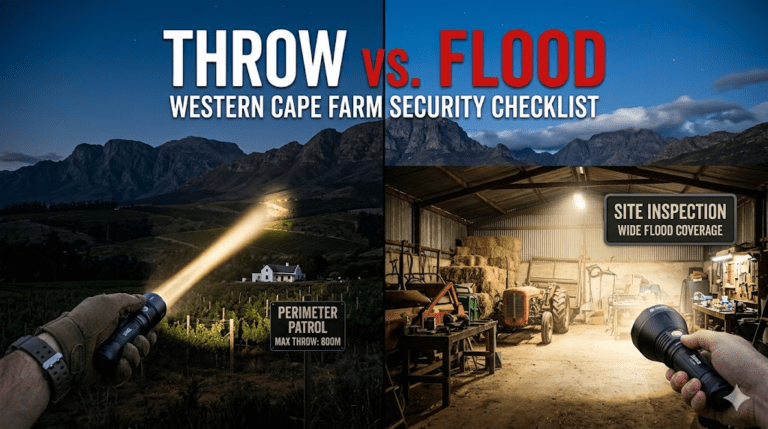
- Lumens (The Flood): This measures the total amount of light emitted by the LED in all directions. Think of it as the raw volume of light. A high-lumen torch without a focused reflector will give you a massive, wide wall of light—perfect for lighting up a campsite or a garage during a power outage, but terrible for distance.
- Candela (The Throw): This measures the peak beam intensity. Candela tells you how tightly that light is focused into a concentrated hotspot. High candela is what pushes the beam deep into the darkness, allowing you to identify a target hundreds of meters away.
The Bakkie Analogy: Horsepower vs. Torque
If you are struggling to picture the difference, think of candela vs lumens for security the same way you think about horsepower and torque in your bakkie.
Lumens are like Horsepower: A 500-horsepower sports car has incredible overall power and top speed. But if you hitch a heavy cattle trailer to it and point it at a muddy farm road, it is going to spin its wheels and go nowhere. The power isn’t applied correctly for the job.
Candela is like Torque: A 4×4 turbo-diesel might only have 150 horsepower, but it has massive torque. It takes that power and drives it directly into the dirt, pulling the trailer straight through the mud.
A high-candela torch takes the available light and drives it straight downrange.
The 300-Meter Tactical Test
Let’s put this into a real-world farm security scenario. You are standing on your stoep, trying to identify a potential threat 300 meters away near the kraal.
Scenario A: The 2000-Lumen “Flood” Torch (Low Candela)
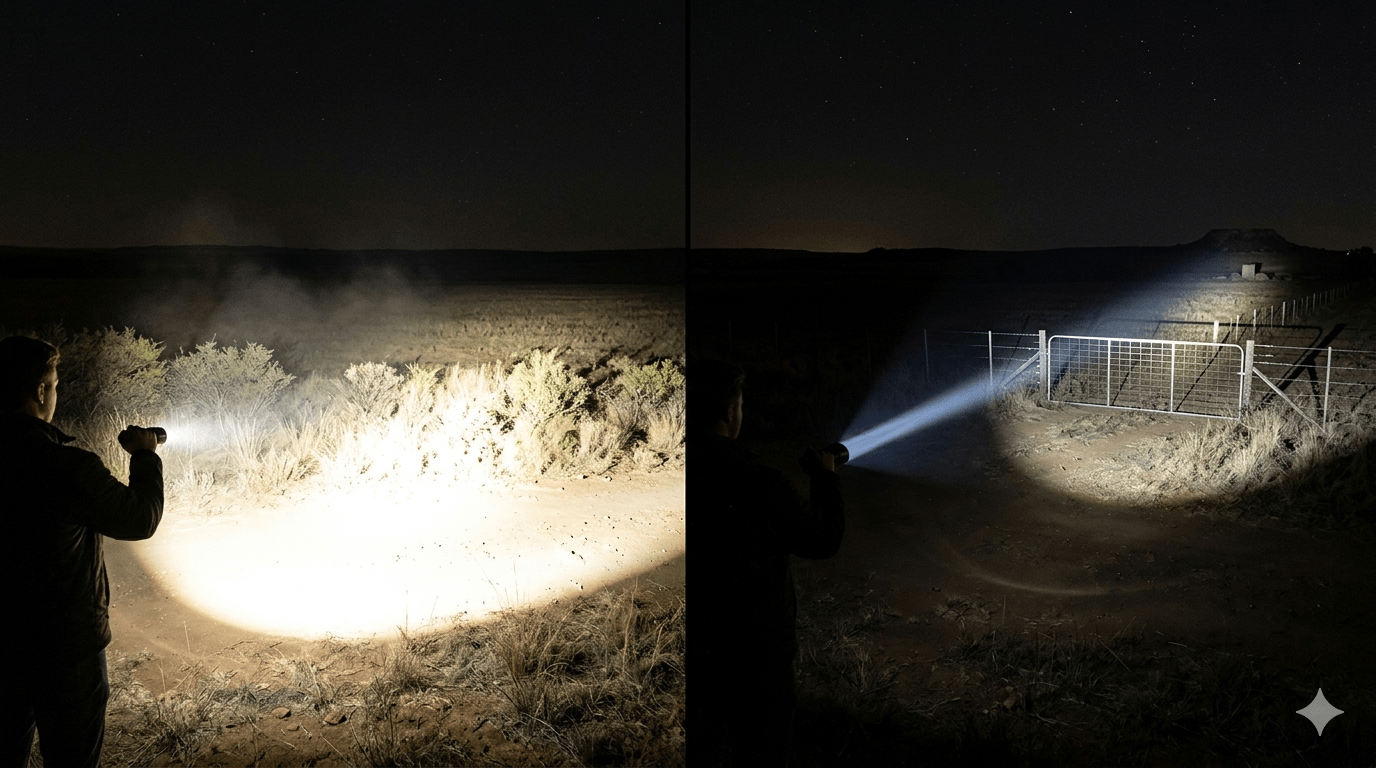
You turn it on. Instantly, the ground, the trees, and the dust in the air 20 meters in front of you are lit up like a sports stadium. This creates massive “spill.” The intense light bouncing off the foreground actually causes your pupils to constrict, ruining your natural night vision. Because the light isn’t focused, it scatters before it reaches the kraal. You are effectively blinded by your own torch, and the suspect remains hidden in the shadows.
Scenario B: The 1000-Lumen Speras Tactical Torch (High Candela)
You turn it on. Instead of washing out the foreground, a tight, laser-like column of light punches straight through the atmospheric dust and mist. It bypasses the nearby trees and puts a brilliant, concentrated hotspot directly on the kraal. Even though this torch has half the lumens of the hardware store brand, its high candela rating means you can clearly see the suspect, what they are wearing, and what they are holding.
Why Candela is Non-Negotiable for Farm Watch
For plaaswag patrols and rural property owners, the primary function of a flashlight is not just illumination—it is early identification and threat deterrence.
- Distance Equals Time: In a security situation, time is your most valuable asset. A high-candela beam allows you to spot a broken fence, a suspicious vehicle, or a trespasser long before they are in your immediate vicinity.
- Punching Through Environmental Barriers: The South African veld is rarely perfectly clear. Smoke from winter fires, dust kicked up by wind, and heavy coastal mist will reflect a wide, flood-style beam right back into your eyes. A high-candela beam cuts through these barriers.
- Target Isolation: A concentrated beam acts as a psychological deterrent. Hitting a trespasser with an intense hotspot clearly communicates that they have been spotted, often ending an intrusion before it escalates.
Finding the Best Torch for Farm Patrol in South Africa
Historically, getting high candela meant carrying a massive, heavy spotlight with a massive battery. Today, advancements in LED technology and deep-reflector design mean you can carry extreme throw in a flashlight that fits on your belt.
When searching for the best torch for farm patrol South Africa, you don’t need to pay the premium for overpriced “lifestyle” brands just to get a good beam. You need duty-grade reliability, standard easily replaceable batteries (like 18650 or 21700 cells), and a reflector mathematically engineered to maximize candela.
Your Action Plan:
Next time you upgrade your everyday carry or farm patrol gear, look past the giant “3000 LUMENS!” sticker on the box. Check the specs. Look for the candela rating and the ANSI beam distance. Choose the tool built for the reality of the South African bush.
Ready to upgrade your tactical lighting system? Equip yourself with gear built for the job. Browse the rugged, high-candela Speras Tactical and Hunting range on our South African store today and take back the night.