A Mechanic’s Guide: Why Right-Angle and Magnetic Lights are Non-Negotiable
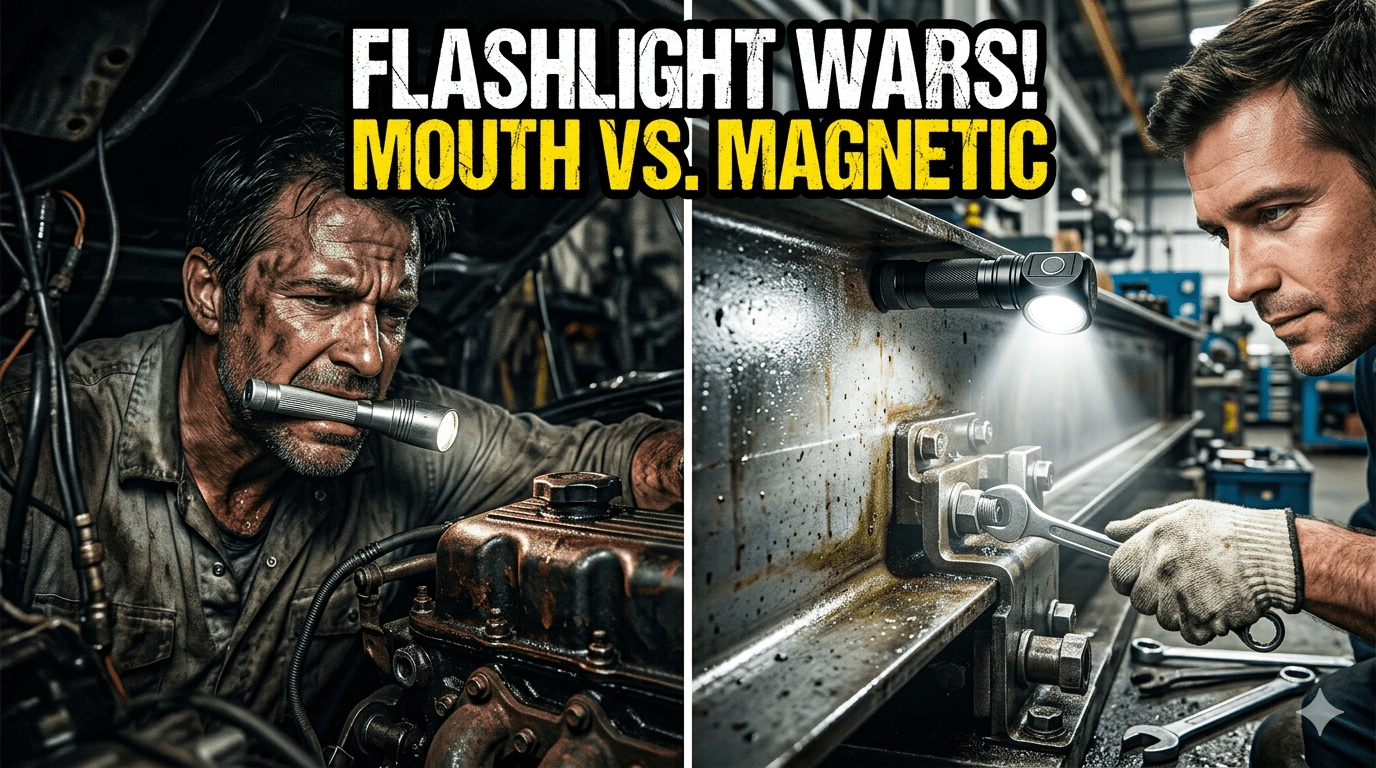
Every seasoned technician knows the miserable, unsanitary reality of the “mouth-hold.” You are crammed beneath a steering column, trying to back out a seized bolt. You need both hands on your spanners, so you wedge an oily, cylindrical torch between your teeth. Your jaw aches, you are swallowing grit, and the moment you need to curse, the light drops into the footwell.
If this sounds familiar, your lighting setup is holding you back. In a professional workshop or a serious DIY garage, a standard tube flashlight is an obsolete tool. It is a liability that occupies a hand you desperately need.
Upgrading to a right-angle light with a magnetic tail-cap is not a luxury; it is the equivalent of acquiring a reliable “third hand.” Here is why this specific geometry and mounting capability is a non-negotiable investment for the trades.
The Geometry of the Right-Angle Light
The primary flaw of a traditional flashlight is its linear projection. To illuminate a target, the body of the light must point directly at it. In the cramped topography of an engine bay or behind heavy machinery, you rarely have the physical space to position a linear torch and a set of hands.
A right-angle light solves this geometric nightmare. Emitting light at 90 degrees to its body, it completely alters how you approach a workspace:
- Chest-Mounting: Equipped with a robust, two-way pocket clip, a right-angle light can be secured directly to the front pocket or bib of your overalls. The light projects perfectly forward, illuminating exactly what your hands are working on, entirely hands-free.
- Vertical Standing: When placed flat on a workbench or the floor, a right-angle light aims horizontally across the workspace, rather than uselessly up at the ceiling.
The Magnetic Tail-Cap Advantage
When you are working beneath a vehicle or deep inside a chassis, you are surrounded by steel. A high-grade magnetic tail-cap allows you to weaponise that environment, turning the vehicle’s frame, the underside of the bonnet, or a two-post hoist into a custom lighting rig.
However, a crucial distinction must be made between consumer-grade magnets and professional tool-grade magnets.
A cheap magnet will stick to a clean fridge, but attach it to a grease-covered engine block, and the moment you hit a stubborn bolt with an air impact wrench, the vibration will send the light sliding down into the sump. A professional light utilises high-grade neodymium magnets. These hold fast through heavy vibration, hammer strikes, and uneven, dirty surfaces, ensuring your light stays locked exactly where you aimed it.
Trade-Specific Survival Specs
When evaluating a work light, amateurs look entirely at “lumens.” Professionals look at survivability. A 2000-lumen torch is useless if its housing cracks the first time it slips from a muddy tyre. A true mechanic’s light must possess the following specs:
- Chemical Resistance: The workshop environment is highly caustic. Your light will inevitably be submerged in used engine oil, sprayed with harsh brake cleaners, and coated in heavy-duty degreasers. Cheap plastics will warp, cloud, or melt. You require aerospace-grade, hard-anodised aluminium bodies and highly durable O-ring seals.
- Drop Ratings: Gravity is a constant enemy. Your light must be certified to survive repeated 2-metre drops directly onto a concrete workshop floor without compromising its internal electronics.
- Glove-Friendly UI (User Interface): Operating complex rotary dials, touchscreens, or tiny, recessed buttons is impossible when your hands are slick with oil or covered in thick nitrile or leather rigger gloves. You need a proud, highly tactile top switch that gives a definitive mechanical “click” even through heavy padding.
- Flood vs. Spot Beam: Tactical torches use narrow “spot” beams designed to throw light hundreds of metres down an alley. In an engine bay, a spot beam creates a blinding glare off bare metal and casts deep, confusing shadows behind every belt and pulley. Mechanics require a wide, diffused “flood” beam that blankets the entire working area in even, consistent light.
The Bottom Line
A mechanic is only as fast as their hands, and only as accurate as their vision. Clinging to a straight-body torch that requires constant readjustment is costing you time, skin on your knuckles, and unnecessary frustration. Treat your lighting with the same scrutiny you apply to a high-end socket set. Invest in right-angle optics, demand a heavy-duty magnetic base, and get your hands back to doing what they do best: turning the spanner.