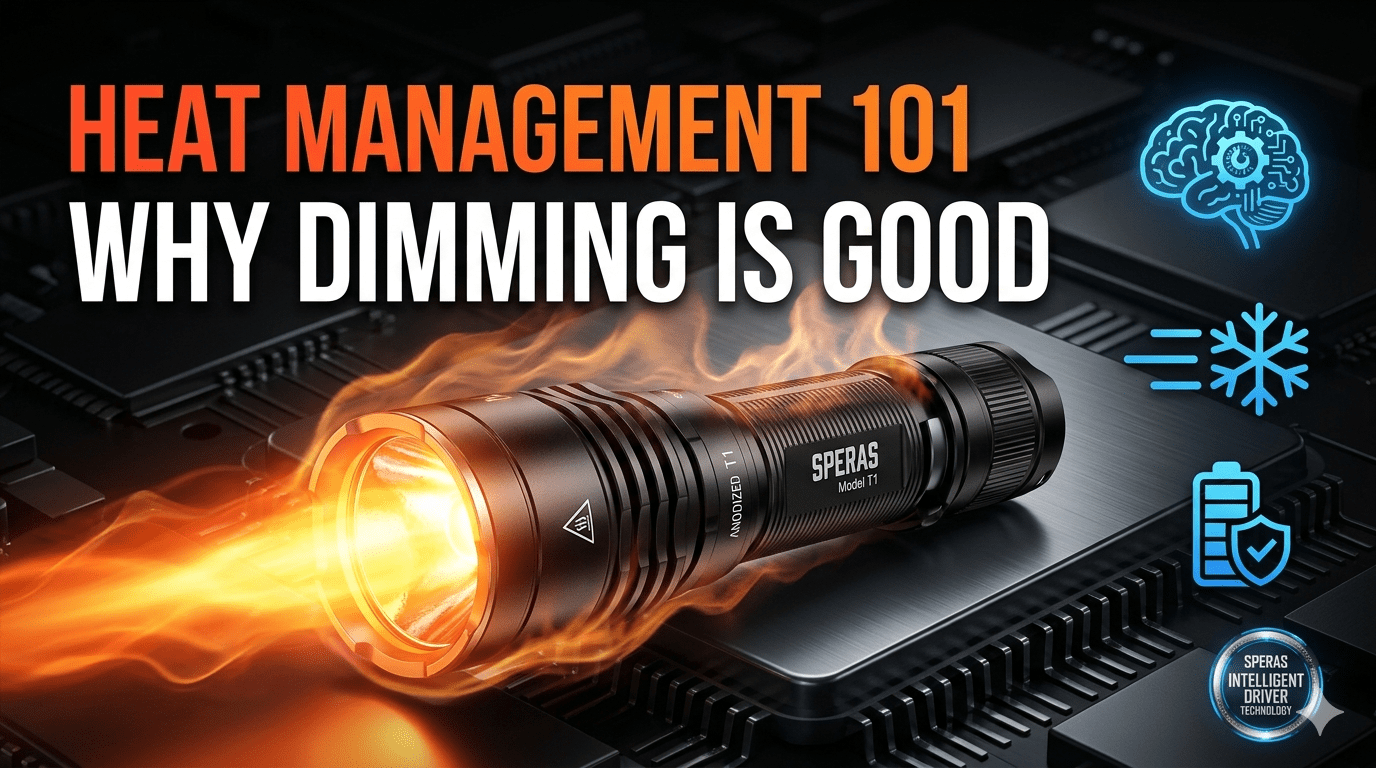
Heat Management 101: Why Your Flashlight Dims (and Why That’s Actually a Good Thing)
You’ve just clicked your high-performance flashlight into “Turbo” mode. The darkness vanishes, and you have a wall of light that turns night into day. But then, after a few minutes of intense output, you notice something: the beam has dimmed.
Is your battery failing? Is the flashlight broken? Should you be worried?
The short answer: Absolutely not.
In reality, that dimming is your flashlight’s intelligent “brain” at work, actively protecting both the device and your investment. Here is why thermal throttling is actually a hallmark of top-tier gear.
The Science Behind the Step-Down: Thermal Throttling
To understand why your flashlight dims, think of it like a high-performance sports car. If you keep the engine at the redline indefinitely, it will eventually overheat and suffer catastrophic damage. To prevent this, modern cars have cooling systems and rev-limiters.
High-performance flashlights function exactly the same way. When an LED is pushed to its maximum potential, it generates an immense amount of heat. If that heat has nowhere to go, it builds up rapidly inside the flashlight head.
“Thermal throttling” is a safety mechanism built into the flashlight’s driver (its internal computer). When the internal sensors detect that the temperature has reached a critical threshold, the driver automatically reduces the power output to allow the LED and the circuitry to cool down.
Why This Is Actually Great News
While it might be frustrating to lose that initial burst of light, this feature is vital for three major reasons:
- Longevity of the Emitter: LED chips have a finite lifespan. Excess heat is the #1 enemy of that lifespan. By regulating temperature, your light ensures the LED stays efficient and bright for thousands of hours rather than burning out prematurely.
- Protection for Your Hand: Modern flashlights are incredibly compact. If they didn’t throttle, the aluminum body would become too hot to hold comfortably within minutes of Turbo use.
- Battery Safety: Intense heat isn’t just bad for the light; it’s bad for the battery. Lithium-ion batteries have a narrow “comfort zone.” By managing heat, the light prevents the battery from becoming unstable or suffering permanent capacity loss due to thermal stress.
Did You Know?
Even the most expensive flashlights in the world use thermal regulation. A light that doesn’t dim when pushed to its limits is often a sign of poor engineering, as it likely lacks the internal sensors needed to monitor heat, putting the entire unit at risk of failure.The Speras Advantage: Intelligent Engineering
At Speras, we don’t just build lights; we engineer systems. Our flashlights are designed with sophisticated thermal management circuitry that balances raw power with sustainable output.
We prioritize a “smart” step-down curve. This means our lights are programmed to provide maximum brightness for as long as physics allows, only dimming when strictly necessary to keep the core components safe. Once the light dissipates that heat into the environment, the driver is often able to maintain a high, stable level of output rather than fluctuating wildly.Conclusion: Trust the Tech
The next time you see your flashlight dim, don’t view it as a failure. View it as a sign of a high-quality, intelligently designed tool that is actively working to keep itself—and you—safe. It is the difference between a throwaway gadget and a professional-grade instrument that you can rely on for years of service.
Ready to experience high-performance gear that respects its own limits?
Explore our latest Speras collection today and discover the difference that precision engineering makes. Whether you’re in the field or at home, we have the light that’s built to last.