The Tactical Advantage: Using High-Intensity Strobe for Self-Defense and Anti-Hijacking
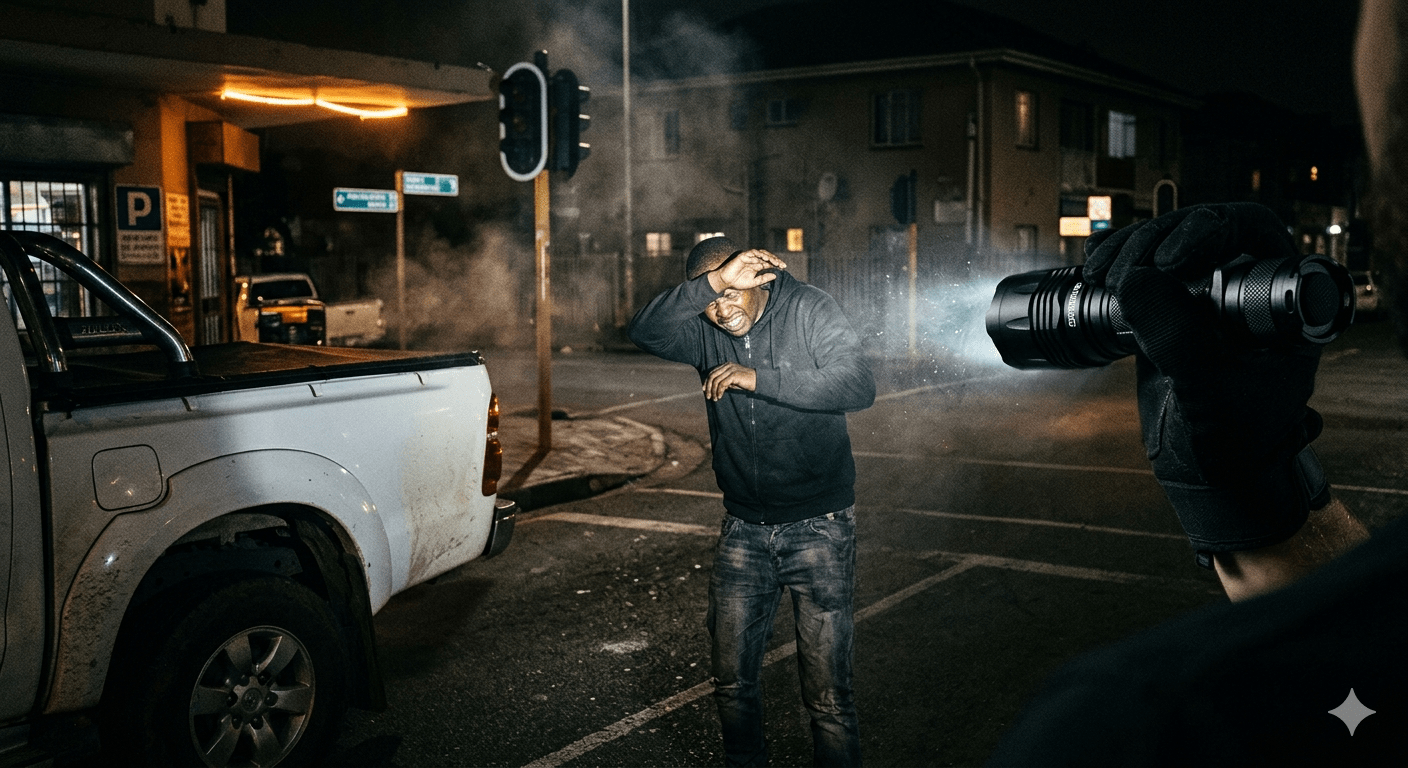
It is 10:00 PM. You are driving home, and the area is completely dark due to load-shedding. You slow down at a dead robot (intersection). As your bakkie comes to a halt, you notice movement in your peripheral vision—two figures moving rapidly toward your driver-side window from the blind spot.
In a high-stress, rapidly escalating situation like a vehicle hijacking or a home invasion, your primary objective is survival. Many South Africans carry a firearm or pepper spray, but they overlook the most accessible, legally unrestrictive, and highly effective non-lethal weapon available: light.
But we are not talking about using light just to see. We are talking about using light to physically and psychologically incapacitate a threat. To do that, you need to understand the true mechanics of a strobe flashlight for self defense in South Africa.
The Non-Lethal Weapon: Seeing vs. Blinding
The average civilian views a flashlight as an illumination tool. Tactical professionals view it as a force multiplier.
When you are confronted by an attacker in the dark, they have the advantage of surprise and, often, dark-adapted vision. If you simply turn on a standard torch, you illuminate the area, which helps you see them, but it also illuminates you, making you a clear target.
This is where the tactical application of strobe comes into play. A dedicated anti-hijacking torch doesn’t just illuminate the environment; it turns the environment into a hostile space for the attacker.
The Science of Tactical Flashlight Strobe Effectiveness
Why does a strobe light work? It is not just about being “annoyingly bright.” It is about exploiting human physiology and cognitive processing.
- Optic Nerve Overload: When struck by a high-lumen, high-candela strobe (typically cycling between 15 to 20 flashes per second), the human pupil cannot constrict and dilate fast enough to process the changing light. This physically overloads the optic nerve, causing temporary flash blindness, tearing, and physical pain in the eyes.
- Spatial Disorientation: The rapid flashing creates a “Bucharest effect” or flicker vertigo. The attacker’s brain receives disjointed, stuttering snapshots of their environment instead of a continuous feed. This destroys their depth perception and balance. They cannot accurately gauge how far away you are or where your hands are.
- Disrupting the OODA Loop: In tactical doctrine, every combatant operates on an OODA Loop (Observe, Orient, Decide, Act). A high-intensity strobe completely shatters the “Observe” and “Orient” phases. The attacker’s brain is forced to reset its processing loop with every flash, causing cognitive freezing and hesitation.
In that crucial window of hesitation, you take control of the engagement.
Rules of Engagement: How to Deploy Strobe
Having the tool is useless without the tactic. Here is how a strobe flashlight should be deployed during a suspected hijacking or farm invasion:
1. Constant-On for Identification
If you suspect a threat but haven’t confirmed it (e.g., someone walking toward your perimeter fence), use a momentary burst of constant-on high output. This identifies the target and clearly communicates: “I see you, and you are illuminated.” Often, this alone strips the attacker of their anonymity and deters the crime.
2. Strobe for Escalation
If the threat is confirmed and advancing (e.g., they are reaching for your car door handle or breaking a window), deploy the strobe directly into their face. Keep the beam locked on their eyes.
3. “Move off the X”
This is the most critical rule of civilian tactical lighting: Do not stand still and admire your work. The strobe is not a magical forcefield; it is a distraction device. Once the strobe hits their eyes and they raise their hands or turn away, you use that 2-to-3-second window to move. Drive away, step off the line of attack, retreat behind cover, or draw a secondary weapon if lethal force is justified.
The Hardware Reality: Why Your Hardware Store Torch Will Fail
Here is the fatal flaw in most civilian flashlights: the user interface (UI).
When a hijacking initiates, your heart rate instantly spikes to over 140 beats per minute. Adrenaline floods your system, and auditory exclusion and tunnel vision set in. Most importantly, you lose your fine motor skills.
If you are carrying a generic hardware store torch that requires you to press the button three times, or cycle through “Low > Medium > High > SOS” just to find the strobe, you will fail. Under stress, you will fumble the switch, turn the light off by accident, and become a victim.
A true tactical flashlight designed for self-defense must have instant, one-touch access to strobe.
This is what separates professional gear from consumer gadgets:
- Dedicated Tactical Switches: You need a dual-switch tail cap where one large, easily identifiable paddle or button instantly activates the blinding strobe, regardless of what mode the flashlight was previously in.
- Aggressive Strike Bezels: The front of the torch should feature a hardened bezel, allowing it to act as an impact weapon or an emergency glass breaker if you need to escape a vehicle.
- High Candela: As discussed in our previous guide, high lumens aren’t enough. You need high candela to push that strobe intensity directly into the attacker’s retinas, even through a tinted car window.
Equip Yourself for the Reality of South Africa
Hope is not a security strategy, and relying on SAPS response times during an active home invasion or hijacking is not a survival plan. You are your own first responder.
Equipping yourself with a purpose-built tactical flashlight is one of the most effective, legally sensible decisions you can make for your personal safety. Stop relying on generic tools for life-or-death situations. Browse the Speras Tactical Flashlights range today. Look specifically for our models featuring instant-strobe dual tail switches, and put a true tactical advantage in your pocket.