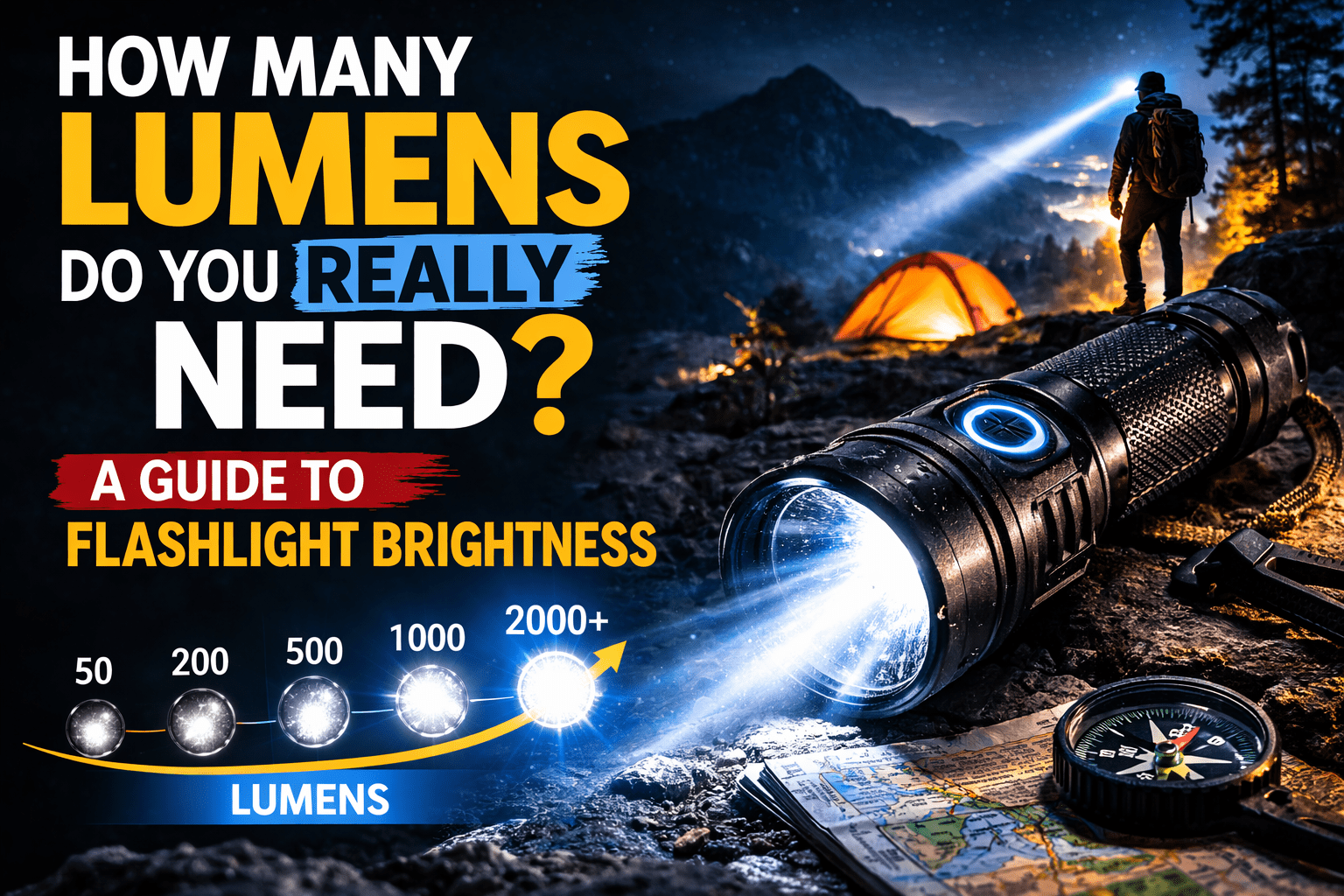
How Many Lumens Do You Really Need? A Guide to Flashlight Brightness
When shopping for a flashlight, one of the first specifications you’ll notice is lumens. Many people assume that the higher the lumen rating, the better the flashlight. While brightness is certainly important, lumens alone do not tell the full story about how a flashlight performs in real-world situations.
Different activities require different brightness levels. A light designed for reading a map at a campsite will have very different requirements from one used for search operations or nighttime hiking.
In this guide, we’ll explain what flashlight lumens are, how brightness works, and how to choose the right lumen level for your needs. If you’re looking for high-performance lighting equipment designed for reliability and brightness, you can explore professional lighting options in the Speras LED Flashlights range.
What Are Lumens?
Lumens are a measurement of total visible light output produced by a light source. In simple terms, lumens indicate how bright a flashlight appears.
The higher the lumen rating, the more light the flashlight emits. For example:
- 50 lumens produces a soft, low-intensity light
- 300 lumens provides strong illumination for most everyday tasks
- 1000+ lumens produces very powerful lighting capable of illuminating large areas
Lumens replaced older brightness measurements that were based on wattage. While wattage measures energy consumption, lumens measure actual light output, making them a far more accurate way to compare flashlights.
However, brightness alone does not determine how effective a flashlight will be in different environments.
Why Lumens Are Not the Whole Story
While lumens measure total light output, they do not indicate how the light is distributed. This is where other factors such as beam pattern and candela come into play.
Beam Pattern
Flashlights generally produce either a flood beam or a throw beam.
- Flood beams spread light across a wide area
- Throw beams focus light into a narrow beam for long-distance visibility
Two flashlights with identical lumen ratings may perform very differently depending on their beam pattern.
Candela
Candela measures beam intensity, which determines how far the light can travel.
A flashlight with high candela produces a focused beam that reaches greater distances. This is why some flashlights with lower lumens can still outperform higher-lumen models in long-distance visibility.
Understanding the relationship between lumens, beam pattern, and candela helps explain why brightness numbers alone do not always reflect real-world performance.
Recommended Lumens for Different Activities
Different tasks require different levels of illumination. Choosing the right brightness helps balance visibility with battery efficiency.
| Activity | Recommended Lumens |
|---|---|
| Reading or close tasks | 20–50 lumens |
| Around the house | 100–200 lumens |
| Camping and general outdoor use | 200–400 lumens |
| Night hiking | 300–600 lumens |
| Security patrol | 500–1000 lumens |
| Search and rescue | 1000+ lumens |
For many users, a flashlight with multiple brightness modes is the best option because it allows you to adjust the output depending on the situation.
High Lumen Flashlights Explained
High-performance flashlights today can produce 1000 lumens or more, delivering extremely powerful illumination.
These flashlights are designed for situations where strong visibility is required, such as:
- outdoor exploration
- professional security work
- search operations
- emergency response
High-lumen flashlights can illuminate large areas and help identify objects at significant distances.
However, higher brightness also means increased battery consumption and heat generation. Because of this, many high-powered flashlights include turbo modes that deliver maximum brightness for short periods before returning to lower levels.
Low Lumen Modes and Battery Efficiency
While high brightness is useful, low lumen settings are equally important.
Many modern flashlights include low or eco modes that produce minimal light output while dramatically extending battery life.
Low brightness levels are useful for tasks such as:
- reading maps
- navigating campsites
- preserving night vision
- conserving battery power during long trips
Some flashlights can run for dozens of hours or even days when operating in low-power modes.
This flexibility makes multi-mode flashlights much more practical for everyday and outdoor use.
Battery Life and Runtime Considerations
Flashlight brightness directly affects battery life. The higher the brightness setting, the faster the battery will drain.
Several factors influence runtime:
- battery capacity
- LED efficiency
- brightness mode
- thermal management
High-quality flashlights use efficient LEDs and smart power management systems to maximize runtime without sacrificing performance.
Rechargeable lithium-ion batteries such as 18650 or 21700 cells are commonly used in modern high-performance flashlights because they offer excellent energy capacity and reliable performance.
How to Choose the Right Brightness
Selecting the right flashlight brightness depends on how the light will be used.
Consider the following factors when choosing a flashlight:
Environment
Outdoor environments often require higher brightness levels to illuminate trails or distant objects.
Distance
Long-distance visibility requires stronger beams with higher candela values.
Battery Life
Lower brightness modes provide longer runtime and may be more practical for extended use.
Portability
Smaller flashlights are easier to carry but may have lower maximum brightness.
Balancing these factors helps ensure you choose a flashlight that matches your specific needs.
Flashlight Technology Continues to Improve
Advances in LED technology have dramatically improved flashlight performance over the past decade.
Modern flashlights are now capable of producing extremely high brightness levels while remaining compact and energy efficient. Improved optics and battery technology also allow manufacturers to deliver better beam control and longer runtime.
These innovations have made high-performance lighting tools more accessible than ever before.
Final Thoughts
Lumens are an important specification when evaluating flashlights, but they are only one part of the equation. Real-world performance depends on several factors, including beam intensity, optical design, battery efficiency, and durability.
The best flashlight is not necessarily the one with the highest lumen rating, but the one that delivers the right balance of brightness, beam distance, and runtime for the intended task.
Whether you’re exploring the outdoors, preparing for emergencies, or simply looking for a reliable lighting tool, understanding flashlight brightness helps you choose equipment that performs when you need it most.
If you’re searching for high-performance lighting equipment engineered for durability and efficiency, explore the Speras LED Flashlights range designed to deliver powerful illumination in demanding environments.