Beyond Lumens: Why Your Loadshedding Strategy Needs Runtime Efficiency Instead of Brightness
If you’ve spent any time shopping for a new flashlight, you’ve likely been bombarded by a single, massive number: Lumens.
Marketing departments love big numbers. It’s easy to sell a “5,000-lumen monster” because it sounds impressive. But ask any South African who has spent a 4-hour stretch in the dark during Stage 6 loadshedding, and they’ll tell you the same thing: The brightest light is often the first one to fail.
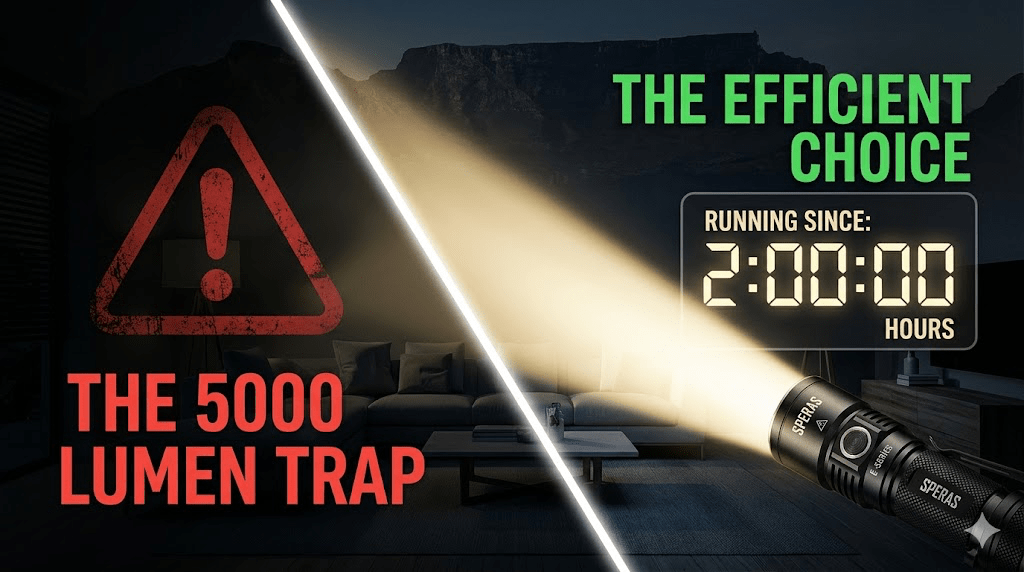
If your flashlight dies 30 minutes into a blackout because it pushed all its energy into a blinding “turbo” burst, that high-lumen rating wasn’t a feature—it was a trap.
The “Lumens Trap”
Most consumers shop for flashlights like they shop for cars: they look for top speed. But just like you wouldn’t drive a Formula 1 car through city traffic, you don’t need a tactical searchlight for finding a candle in the kitchen.
The “Lumens Trap” happens when a flashlight is engineered for a 30-second “wow” factor rather than real-world reliability. You turn it on, the room is flooded with light, and you feel great. Twenty minutes later, the light is dimming, the casing is scorching hot, and you’re left searching for spare batteries by the light of a cellphone.
The Physics of Failure: Why Heat Kills Runtimes
To understand why your light dies so quickly, think of your flashlight like a high-performance car engine.
- Heat Generation: High-lumen output requires massive amounts of power. As this energy flows through the LED and the driver, it generates intense heat.
- Thermal Throttling: Most high-end lights have built-in sensors. When the body of the light gets too hot, the internal computer—the driver—automatically dims the brightness to protect the internal components from melting. You aren’t getting the “advertised” lumens; you’re getting whatever the light can manage while it fights to keep from self-destructing.
- Battery Drain: Pushing maximum power is like flooring the accelerator on the highway. You’ll get to your destination fast, but you’ll burn through your fuel (battery) in a fraction of the time.
The Speras Standard: Engineered for the Long Haul
At Speras, we believe that usable light is better than maximum light.
We prioritize Driver Efficiency. Our drivers are designed to regulate power delivery with precision. Instead of dumping all the battery capacity into the LED at once, our systems maintain a stable, consistent output. This means that if you need 300 lumens to move through your home during a blackout, you get 300 steady, reliable lumens for hours on end—not a fluctuating beam that dies after a short window.
Why this matters for your home:
- Thermal Management: Our aircraft-grade aluminum bodies are designed to dissipate heat efficiently, preventing the “throttle-down” effect that plagues cheaper lights.
- Predictable Performance: You need to know that your light will last from the start of the blackout to the return of the power. Speras lights are built to provide consistent runtimes that you can actually bank on.
Performance Comparison: Real-World Usage
| Feature | “High-Lumen” Commodity Light | “Speras High-Efficiency” Light |
| Initial Brightness | 5,000 Lumens | 1,500 – 1,900 Lumens |
| Output Stability | Dims drastically after 5–10 mins | Consistent brightness for hours |
| Heat Management | Poor (Becomes hot to touch) | Superior (Thermal regulation) |
| 4-Hour Blackout | Often fails or requires battery swap | Reliably maintains output |
Conclusion: Don’t Buy the Hype, Buy the Reliability
When you are sitting in the dark, you don’t need a light that mimics the sun for ten minutes. You need a companion that stays on, stays bright enough to work, and stays cool in your hand.
Don’t let the marketing numbers fool you. Invest in the engineering that keeps you powered through the longest, darkest stages of loadshedding.
Ready to upgrade your home emergency kit?
[Explore our Long-Runtime Collection] and see the difference that efficient engineering makes. Your next blackout doesn’t have to be a struggle.