How Many Lumens Do You Really Need? A Practical Guide to Flashlight Brightness
When people shop for a flashlight, the first specification they usually look at is lumens. Many assume that the higher the lumen number, the better the flashlight. While brightness is important, choosing the right flashlight involves more than simply picking the model with the largest lumen rating.
In reality, the ideal brightness level depends on how and where the flashlight will be used. A flashlight designed for reading inside a tent does not need the same brightness as one used for search and rescue or night patrols.
Understanding how lumens work—and how they relate to beam pattern and distance—can help you select a flashlight that performs effectively without wasting battery power or producing unnecessary glare. In this guide, we’ll explain what lumens actually measure and how to choose the right brightness level for different activities.
What Lumens Actually Measure
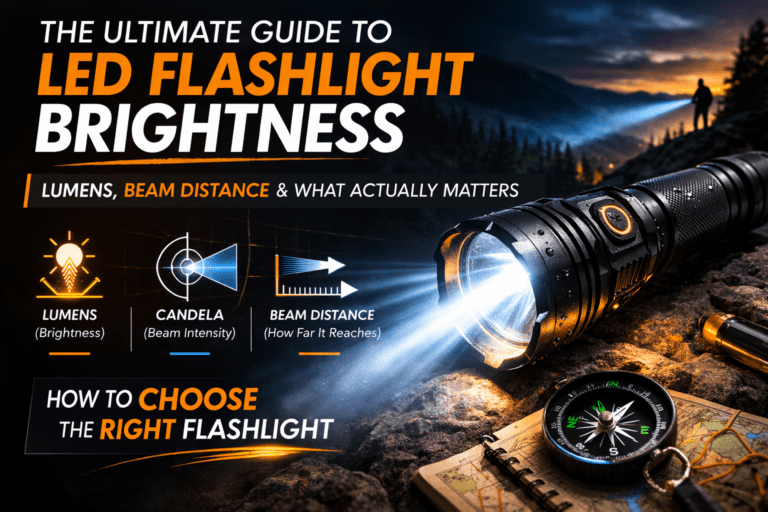
Lumens are the standard unit used to measure the total amount of visible light emitted by a source. In the case of flashlights, lumens indicate the total brightness produced by the LED.
However, lumens only describe how much light is produced, not how the light is distributed.
Two flashlights with the same lumen rating can behave very differently depending on their optics and beam design. One flashlight may produce a wide flood beam that illuminates a large nearby area, while another may concentrate the light into a narrow beam that reaches much farther.
This is why lumen numbers should always be considered alongside other factors such as:
- Beam intensity (candela)
- Beam distance
- Beam pattern
Understanding this relationship helps explain why some flashlights with moderate lumen levels can still outperform brighter models in certain situations.
Low Lumens: Everyday Tasks
Flashlights with 10 to 150 lumens are designed for simple, close-range tasks.
These lights provide enough illumination for situations where intense brightness is unnecessary and could even be uncomfortable. Low-lumen flashlights are especially useful when you want to conserve battery power or preserve night vision.
Common uses for low-lumen flashlights include:
- Reading maps or instructions
- Finding items inside a bag
- Navigating indoors during a power outage
- Moving around a campsite at night
- Performing basic household tasks
Many high-quality flashlights include a low mode specifically for these situations. Using a lower brightness level also significantly extends battery life.
Medium Lumens: Outdoor Activities
Flashlights producing 150 to 500 lumens are among the most versatile options for outdoor use. This brightness range provides a good balance between illumination and battery efficiency.
Medium-lumen flashlights are commonly used for:
- Camping
- Hiking
- Dog walking at night
- Exploring trails
- General outdoor navigation
At this brightness level, the flashlight provides enough visibility to navigate safely while still maintaining reasonable battery life. For many outdoor enthusiasts, this range represents the most practical brightness level for everyday use.
High Lumens: Tactical and Professional Use
Flashlights in the 500 to 2000 lumen range are typically designed for more demanding environments where strong illumination is required.
These lights are commonly used by:
- Security professionals
- Search teams
- Hunters
- Emergency responders
- Outdoor explorers
Higher lumen levels allow users to illuminate larger areas or identify objects at greater distances. However, high brightness also generates more heat and consumes battery power more quickly.
For this reason, many high-performance flashlights include multiple brightness modes that allow users to switch between lower and higher outputs depending on the situation.
Extreme Lumens: High-Performance Flashlights
Some modern flashlights produce 2000 lumens or more, with certain models reaching 10,000 lumens or beyond. These extremely powerful lights are designed for specialized situations where maximum illumination is necessary.
High-lumen flashlights are often used for:
- Search and rescue operations
- Large outdoor areas
- Marine environments
- Professional tactical applications
- Emergency response
While these lights can produce impressive brightness, they are not always practical for everyday use. High output levels can drain batteries quickly and generate significant heat, so they are typically used in short bursts when maximum illumination is needed.
Beam Distance vs Lumens
Many people assume that a brighter flashlight automatically shines farther, but beam intensity plays an equally important role.
Beam intensity is measured in candela, which indicates how concentrated the light is at its brightest point. A flashlight with higher candela produces a tighter, more focused beam that can reach greater distances.
This explains why a 1000-lumen flashlight with a focused beam may illuminate distant objects better than a 3000-lumen flashlight with a wide flood beam.
Flashlights generally fall into two beam categories:
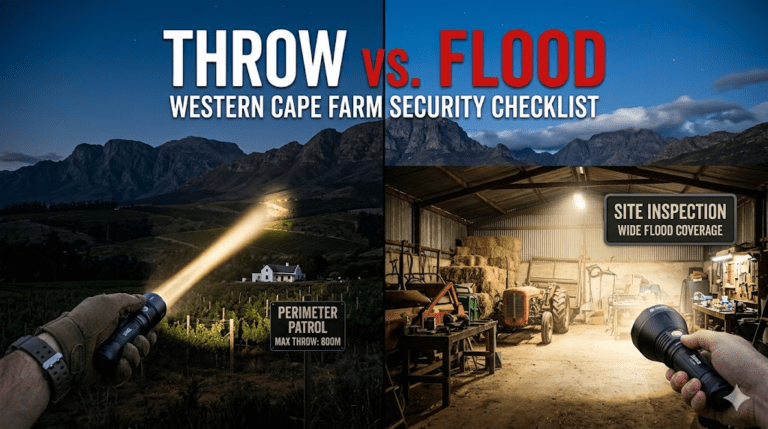
Flood Beams
Flood beams spread light over a wide area. They are ideal for:
- Close-range tasks
- Campsite lighting
- Repair work
- Indoor use
Throw Beams
Throw beams concentrate light into a narrow beam that travels farther. These beams are ideal for:
- Long-distance visibility
- Navigation
- Security patrols
- Search operations
Understanding beam type helps you choose the right flashlight for your intended environment.
Choosing the Right Brightness for Your Activity
Selecting the right brightness level becomes easier when you consider how the flashlight will be used.
Below is a practical guideline for common applications.
| Activity | Recommended Lumens |
|---|---|
| Home emergency use | 50–200 lumens |
| Camping | 100–300 lumens |
| Night hiking | 200–500 lumens |
| Security patrol | 500–1000 lumens |
| Hunting | 600–1500 lumens |
| Search and rescue | 1000–3000+ lumens |
These ranges provide a helpful starting point, but the ideal flashlight also depends on beam pattern, battery type, and runtime.
Why Adjustable Brightness Matters
One of the most useful features in modern flashlights is adjustable brightness modes.
Instead of operating at a single output level, many flashlights offer several brightness settings such as:
- Low mode
- Medium mode
- High mode
- Turbo mode
- Strobe or emergency modes
This flexibility allows users to adapt their lighting to different environments while managing battery life effectively.
For example:
- A low mode may be used inside a tent.
- Medium brightness can illuminate a hiking trail.
- High mode may be used for scanning distant terrain.
This adaptability makes a flashlight far more practical in real-world situations.
Final Thoughts
Choosing the right flashlight is not simply about selecting the highest lumen number available. The best flashlight is one that balances brightness, beam pattern, battery life, and intended use.
Low lumen levels are perfect for everyday tasks and preserving battery life, while medium brightness levels are ideal for most outdoor activities. Higher lumen flashlights provide powerful illumination for professional or tactical environments where distance and visibility are critical.
By understanding how lumens work and how they interact with beam design, you can select a flashlight that delivers reliable performance when you need it most.
At Speras, our lighting tools are designed to provide the right balance of brightness, efficiency, and durability for real-world environments. Whether you’re exploring the outdoors or preparing for emergencies, choosing the right flashlight ensures you always have dependable illumination at hand.