
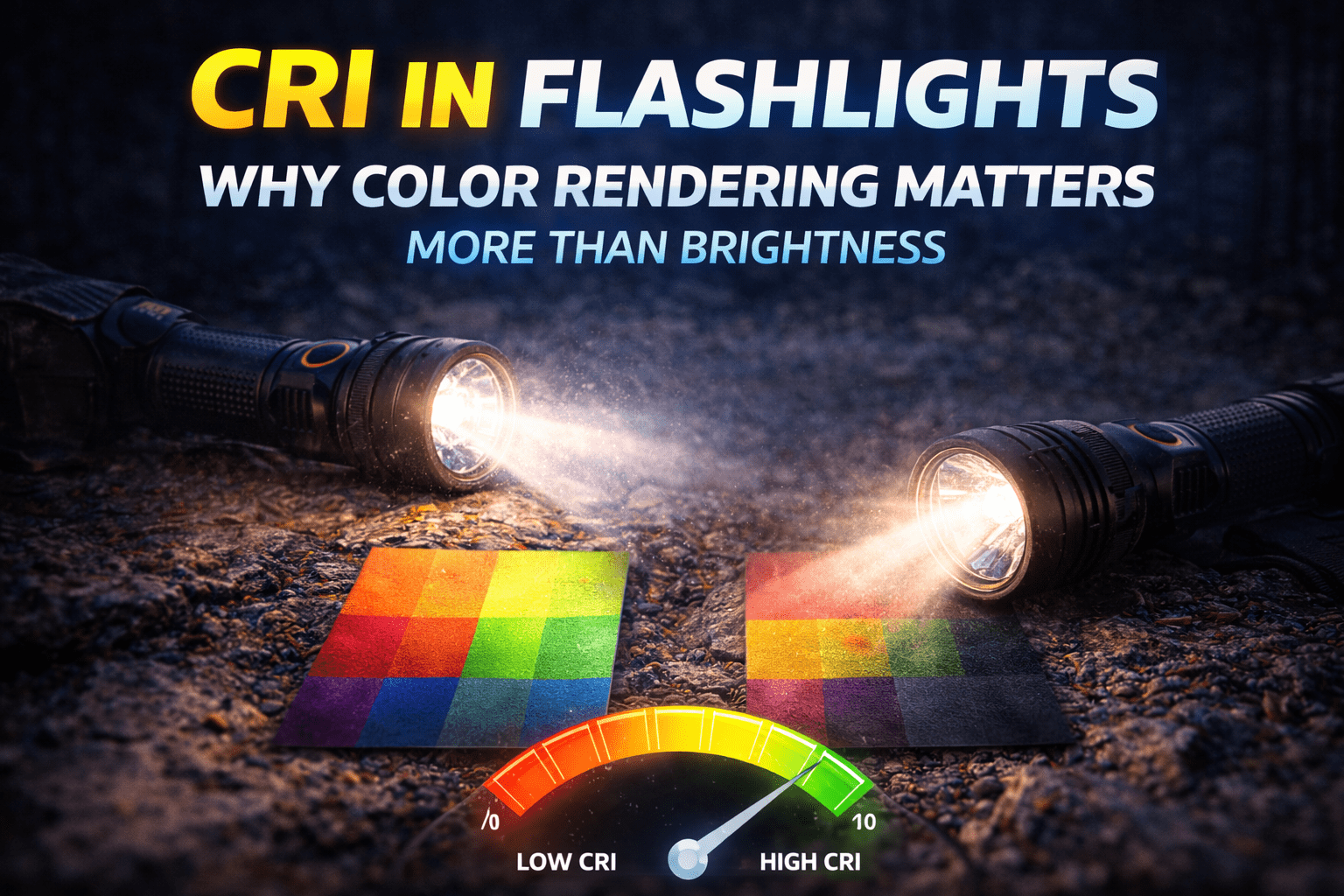
CRI in Flashlights: Why Color Rendering Matters More Than Brightness
When most people shop for a flashlight, they focus almost entirely on lumens, assuming that a higher lumen rating automatically means better visibility. While brightness is certainly important, it is not the only factor that determines how useful a flashlight will be in real-world situations.
One often overlooked specification is CRI, or Color Rendering Index. CRI measures how accurately a light source reveals the true colors of objects compared to natural sunlight. In many situations, accurate color rendering can be just as important as brightness.
In this guide, we’ll explain what CRI in flashlights means, how it affects visibility, and why many professionals and enthusiasts prefer high-CRI lighting for certain applications. If you’re looking for powerful lighting tools engineered for real-world performance, you can explore professional options in the Speras LED Flashlights collection.
What Is CRI?
CRI stands for Color Rendering Index, a measurement used to evaluate how accurately a light source reveals colors when compared to natural daylight.
The CRI scale ranges from 0 to 100:
- 100 CRI represents perfect color accuracy, similar to natural sunlight.
- Lower CRI values indicate that colors may appear distorted or washed out under the light.
For example, under a low-CRI light source, a red object might appear dull or brownish, while under a high-CRI light it will appear closer to its true color.
CRI is particularly important in environments where accurate color identification matters.
Why CRI Matters in Flashlights
In many everyday situations, color accuracy may not seem critical. However, in certain environments, poor color rendering can make it harder to interpret what you are seeing.
Identifying Wires and Equipment
Technicians and electricians often rely on flashlights when working in dark environments. Accurate color rendering helps distinguish between colored wires or components.
Outdoor Navigation
When hiking or exploring outdoors, color accuracy helps identify:
- trail markers
- terrain features
- natural obstacles
Low-quality lighting can distort these colors, making it harder to interpret surroundings.
Wildlife Observation
For hunters, photographers, and outdoor enthusiasts, high-CRI lighting allows wildlife and natural environments to appear more natural and detailed.
Equipment Inspection
Professionals performing inspections often need to detect small color differences that could indicate wear, corrosion, or damage.
In these scenarios, high-CRI lighting can significantly improve visibility and accuracy.
High CRI vs Standard LED Flashlights
Most standard LED flashlights prioritize efficiency and brightness, which often results in lower CRI values.
Typical CRI ranges include:
| LED Type | Typical CRI |
|---|---|
| Basic LED flashlight | 60–70 CRI |
| Mid-quality LED | 70–80 CRI |
| High-quality LED | 80–90 CRI |
| High-CRI flashlight | 90+ CRI |
Standard LED flashlights often fall within the 60–70 CRI range, which means colors may appear somewhat distorted.
High-CRI flashlights, on the other hand, use specialized LED emitters designed to produce more accurate color representation.
This improved color rendering helps users see objects more naturally and clearly.
The Trade-Off Between CRI and Efficiency
One reason high-CRI flashlights are less common is that color accuracy often comes at the cost of efficiency.
High-CRI LEDs typically produce:
- slightly lower lumen output
- somewhat reduced battery efficiency
This means a flashlight designed for maximum brightness may use LEDs optimized for efficiency rather than color accuracy.
However, modern LED technology has improved significantly, and many high-quality flashlights are now able to balance brightness, efficiency, and color accuracy.
For many users, the improved visibility provided by high CRI more than compensates for the small reduction in lumen output.
When High CRI Flashlights Are Most Useful
While high-CRI flashlights are beneficial in many situations, they are particularly valuable in certain professional and outdoor applications.
Mechanics and Technicians
Repair professionals often rely on accurate lighting to inspect parts, identify wiring, and detect subtle color changes in components.
Outdoor Exploration
High-CRI lighting can make natural environments appear more vibrant and detailed, improving navigation and overall visibility.
Photography and Videography
Photographers frequently use high-CRI lighting to ensure that subjects appear natural and accurately colored.
Medical and Inspection Work
In professions where precise visual information is important, color accuracy can be essential.
In these environments, high-CRI lighting provides a noticeable advantage.
CRI vs Lumens: Why Brightness Is Not Everything
Many buyers assume that the brightest flashlight is automatically the best choice. However, brightness alone does not guarantee optimal visibility.
Two flashlights may produce the same number of lumens but deliver very different visual experiences depending on:
- beam pattern
- optical design
- color rendering quality
For example, a high-lumen flashlight with low CRI may appear bright but still make it difficult to distinguish certain colors or details.
A slightly less bright flashlight with higher CRI may provide better overall visibility because objects appear more natural and easier to interpret.
This is why professional lighting tools often focus on balanced performance rather than maximum brightness alone.
How to Choose a High-CRI Flashlight
If color accuracy is important for your application, there are several specifications to look for when choosing a flashlight.
Check the CRI Rating
Manufacturers sometimes list CRI values in product specifications. Look for LEDs rated 80 CRI or higher, with 90+ CRI considered high quality.
Consider Beam Quality
A well-designed reflector or lens system can improve the overall clarity of the beam.
Evaluate Brightness Needs
High-CRI flashlights may have slightly lower lumen ratings, but the improved color rendering often results in better practical visibility.
Look for High-Quality LED Emitters
Premium flashlight manufacturers often use advanced LED emitters that provide improved color accuracy while maintaining strong brightness levels.
The Future of High-CRI Flashlight Technology
As LED technology continues to evolve, manufacturers are developing lighting systems that combine high brightness with improved color rendering.
Advances in LED engineering are making it possible to produce flashlights that deliver:
- strong lumen output
- excellent energy efficiency
- improved color accuracy
These improvements allow modern flashlights to provide more natural and useful illumination than ever before.
Final Thoughts
While brightness is an important factor when choosing a flashlight, it is not the only specification that affects real-world visibility. Color Rendering Index (CRI) plays a crucial role in how accurately objects appear under artificial light.
High-CRI flashlights provide more natural color representation, making them valuable for tasks that require detailed visual information. Whether you are working in technical environments, exploring the outdoors, or performing inspections, accurate lighting can significantly improve visibility.
Understanding CRI helps users choose flashlights that deliver not just brightness, but clear, accurate, and dependable illumination.
If you’re looking for high-performance lighting tools designed for real-world conditions, explore the Speras LED Flashlights collection engineered to balance brightness, beam quality, and reliability.


