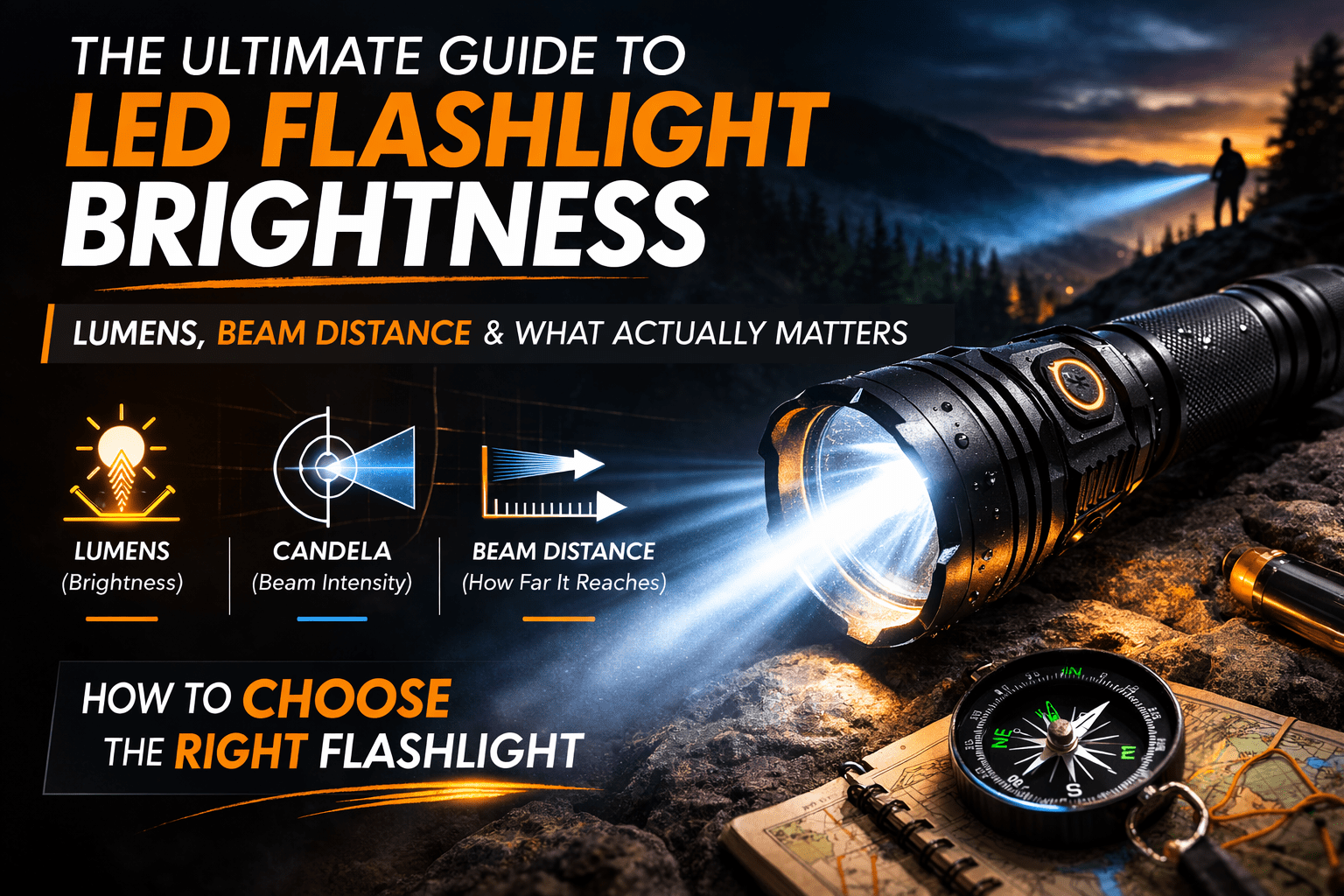
The Ultimate Guide to LED Flashlight Brightness: Lumens, Beam Distance, and What Actually Matters
When people shop for a flashlight, the first number they usually look at is lumens. Manufacturers often advertise increasingly larger numbers — 1,000 lumens, 5,000 lumens, even 20,000 lumens — which creates the impression that more lumens automatically means a better flashlight.
But brightness in modern LED flashlights is far more complex than a single number on a box. Two flashlights with the same lumen rating can perform completely differently depending on beam intensity, optics, beam distance, and thermal regulation.
Understanding how these lighting metrics work is the difference between choosing a flashlight that merely looks impressive on paper and selecting a tool that performs reliably in real-world conditions. Whether you are camping, hunting, working security, or simply preparing for emergencies, knowing how lumens, candela, and beam distance interact will help you choose the right light for the job.
In this guide, we break down how flashlight brightness actually works, explain the industry testing standards used by reputable manufacturers, and show how to determine how many lumens you truly need.
What Lumens Actually Measure
Lumens are the most commonly advertised specification for flashlights, but many people misunderstand what they actually represent.
A lumen is a measurement of the total amount of visible light emitted by a source. In simple terms, lumens measure the total light output produced by the LED.
However, lumens do not describe how the light is distributed.
For example:
- A flashlight that emits 1,000 lumens in a wide flood pattern will illuminate a large area nearby.
- Another flashlight that emits the same 1,000 lumens but focuses the light into a narrow beam may reach much farther into the distance.
Both lights produce the same amount of total light, yet their real-world performance can feel completely different.
This is why lumen numbers alone can be misleading. Without understanding beam intensity and optics, the lumen rating tells only part of the story.
Reputable flashlight manufacturers test lumen output using the ANSI/NEMA FL1 standard, which ensures that brightness measurements are performed consistently and transparently.
Candela and Beam Intensity
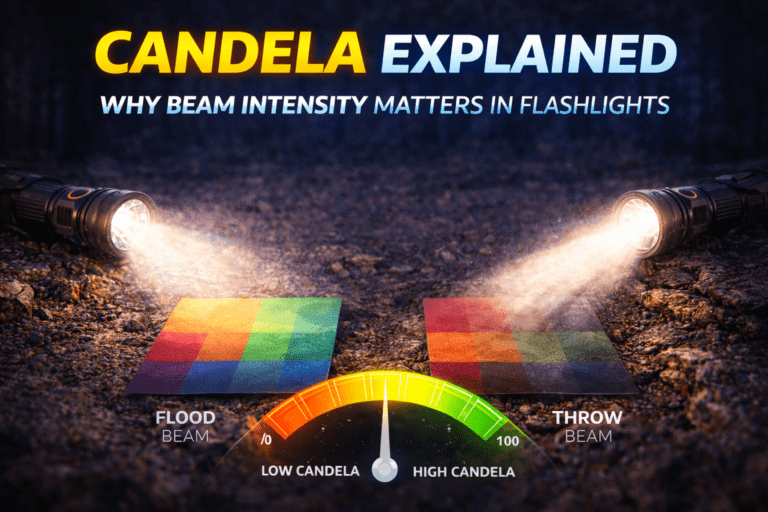
If lumens measure total light output, candela measures the intensity of the beam at its brightest point.
Candela tells you how concentrated the light is.
A flashlight with high candela produces a tight, focused beam that travels further, while a flashlight with lower candela produces a broader flood beam that spreads light over a wider area.
This difference becomes critical depending on how the flashlight is used.
Examples:
Search and rescue operations
Search teams need high candela beams that can illuminate distant terrain or objects.
Hunting and tracking
Hunters often prefer long-throw flashlights that can identify animals or movement at distance.
Camping and general outdoor use
Campers usually benefit from wider flood beams that illuminate surrounding areas rather than distant targets.
In practice, the best flashlight balances lumens and candela according to the intended use.
Beam Distance Explained
Another key metric used in flashlight specifications is beam distance.
Beam distance refers to the maximum distance at which a flashlight can project usable light. This measurement is calculated using the ANSI FL1 beam distance standard, which defines the distance at which illumination drops to 0.25 lux, roughly equivalent to the brightness of a full moon on a clear night.
In simple terms, beam distance indicates how far a flashlight can project light that remains visible to the human eye.
For example:
| Flashlight Type | Typical Beam Distance |
|---|---|
| Everyday carry flashlight | 100–200 meters |
| Outdoor flashlight | 200–400 meters |
| Tactical flashlight | 400–800 meters |
| Searchlight | 1 km or more |
However, beam distance should always be interpreted alongside beam pattern. A flashlight designed for extreme distance may sacrifice wide-area illumination.
Flood vs Throw: Choosing the Right Beam Pattern
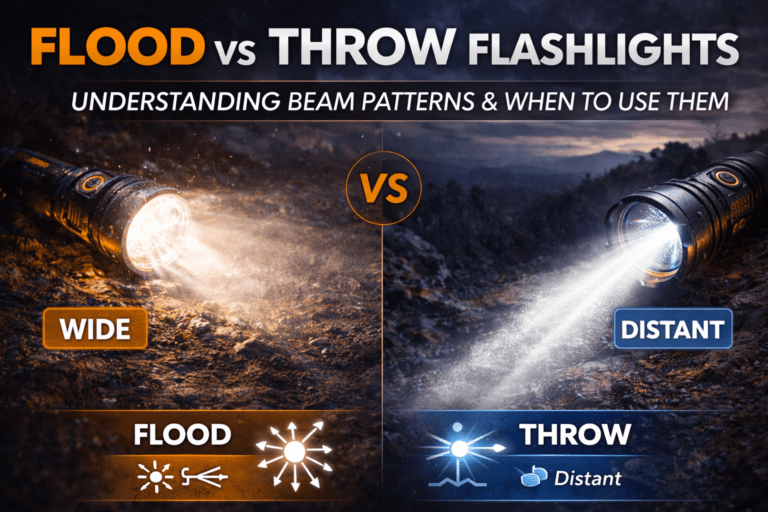
Flashlights generally fall into three beam pattern categories: flood, throw, or hybrid.
Flood Beam
Flood flashlights produce a wide beam with lower intensity. They are designed to illuminate large areas close to the user.
Best for:
- Camping
- Hiking
- Mechanical work
- Indoor use
- Power outages
Flood lights improve visibility in your immediate surroundings rather than projecting light far into the distance.
Throw Beam
Throw flashlights concentrate light into a tight, high-intensity beam capable of reaching significant distances.
Best for:
- Search and rescue
- Hunting
- Security patrol
- Navigation
- Marine environments
High-throw lights rely on specialized reflectors or optical lenses to concentrate the beam.
Hybrid Beam
Many modern tactical and outdoor flashlights combine flood and throw capabilities, providing both near-field illumination and long-distance visibility.
These hybrid designs are increasingly popular because they offer versatility across multiple environments.
How Many Lumens Do You Actually Need?
Choosing the correct brightness depends heavily on how the flashlight will be used.
Here is a practical guide for common applications:
| Activity | Recommended Lumens |
|---|---|
| Reading or indoor use | 20–100 lumens |
| Walking or general household use | 100–300 lumens |
| Camping | 200–500 lumens |
| Hiking or outdoor exploration | 300–800 lumens |
| Security patrol | 800–1500 lumens |
| Hunting | 800–2000 lumens |
| Search and rescue | 2000+ lumens |
Higher lumen flashlights can be extremely powerful, but they are not always necessary for everyday tasks. In fact, excessive brightness can reduce night vision and drain batteries faster.
Many modern flashlights therefore include multiple brightness modes, allowing users to switch between low-power and high-power settings depending on the situation.
LED Efficiency and Battery Life
Brightness and runtime are closely connected.
A flashlight operating at extremely high brightness levels will consume more power and generate more heat. To manage this, high-performance flashlights often include thermal regulation systems that reduce brightness when internal temperatures become too high.
Advances in LED technology have significantly improved efficiency, allowing modern flashlights to deliver impressive brightness while maintaining reasonable battery life.
Battery choice also plays an important role.
Common flashlight battery types include:
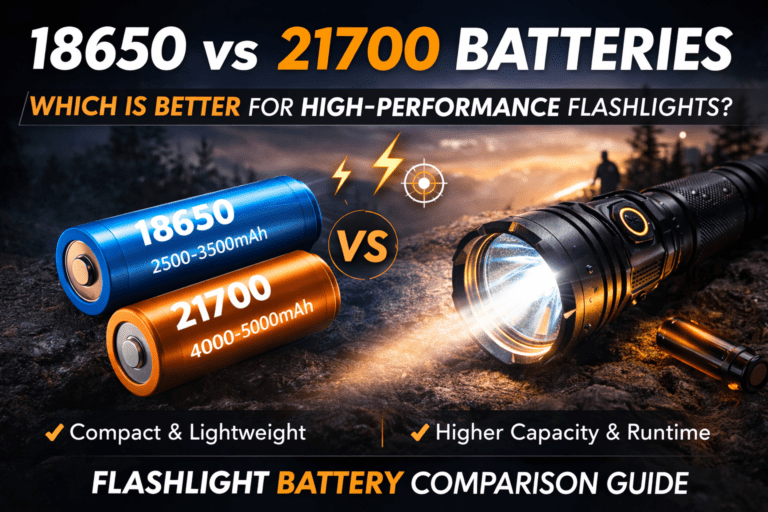
- Rechargeable lithium-ion batteries (18650 or 21700) – high capacity and commonly used in high-performance lights
- AA or AAA batteries – convenient and widely available
- CR123A batteries – often used in tactical flashlights due to their long shelf life
Rechargeable lithium-ion batteries are increasingly popular because they provide excellent performance and reduce long-term operating costs.
Common Flashlight Marketing Myths
With the growing popularity of high-powered flashlights, marketing claims can sometimes create unrealistic expectations.
Here are a few common misconceptions.
“More lumens always means a better flashlight”
Higher lumens can be useful, but beam design and optics determine how effectively that light is used.
A well-designed 1,000-lumen flashlight may outperform a poorly designed 3,000-lumen flashlight.
“Zoom flashlights outperform fixed optics”
Many inexpensive flashlights rely on adjustable zoom lenses. While these can be convenient, they often sacrifice beam quality and efficiency compared to high-quality fixed reflectors or lenses.
Professional-grade flashlights typically use carefully engineered optics rather than zoom mechanisms.
Unrealistic lumen claims
Low-quality flashlights sometimes advertise exaggerated lumen numbers that are not verified using recognized testing standards.
Reputable manufacturers follow the ANSI FL1 testing protocol, ensuring brightness claims reflect real-world performance.
How to Choose the Right Flashlight
When selecting a flashlight, brightness should be evaluated alongside several other factors.
Beam pattern
Decide whether you need a flood beam, throw beam, or combination of both.
Beam distance
Consider how far you need to see clearly.
Battery type
Rechargeable lithium-ion batteries provide excellent performance and runtime.
Durability
Outdoor and tactical flashlights should be built from high-strength materials such as aircraft-grade aluminum.
Waterproof rating
Look for flashlights rated IPX7 or IPX8 if they will be used in outdoor environments.
Runtime
Longer runtime is often more valuable than extreme brightness for extended use.
By evaluating these factors together, you can select a flashlight that performs reliably in the situations that matter most.
Final Thoughts
LED flashlight technology has evolved dramatically over the past decade. Modern lights are smaller, brighter, and more efficient than ever before, but choosing the right flashlight requires more than simply comparing lumen numbers.
Understanding how lumens, candela, beam distance, and beam patterns interact allows you to evaluate flashlights based on real performance rather than marketing claims.
Whether you are preparing for outdoor adventures, professional security work, or emergency situations, selecting a high-quality flashlight built to recognized testing standards ensures that your equipment performs when you need it most.
At Speras, our mission is to design lighting tools that combine power, reliability, and precision engineering for outdoor enthusiasts and professionals who depend on their gear. By focusing on performance, durability, and real-world usability, we aim to deliver flashlights and headlamps that stand up to the demands of modern exploration and field use.