Tactical Flashlights for Private Security: 5 Non-Negotiable Features
In the South African private security landscape, your gear is more than just a convenience—it is a critical component of your safety and operational effectiveness. When patrolling perimeters or responding to alarms, a standard hardware-store torch is a liability.
To maintain a tactical advantage, professional security personnel require lighting tools that offer more than just visibility. Here are the five non-negotiable features every tactical flashlight must have to survive the front line.
1. High-Frequency Strobe and “Deterrence” Power
In a high-stress encounter, light is a non-kinetic tool for de-escalation. A flashlight delivering 2,000+ lumens does more than illuminate; it physically overwhelms the “night-adapted” vision of a potential intruder.
- The Disorientation Effect: A high-frequency strobe mode creates a “flicker vertigo” effect, making it difficult for an adversary to judge distance or motion.
- Tactical Advantage: This split-second window of disorientation provides security officers with a crucial advantage to either retreat to cover or move in for an arrest.
2. Optimized Beam Pattern: Throw vs. Flood
A professional security light must be a “jack of all trades” regarding its beam profile.
- The “Throw” (Distance): Essential for perimeter checks. You need enough “candela” (beam intensity) to see clearly to the end of a dark fence line or across an open parking lot.
- The “Flood” (Breadth): Crucial for “clearing” rooms or inspecting the interior of a vehicle. A beam that is too narrow creates “tunnel vision,” which can cause a guard to miss threats in their peripheral vision.
- The Speras Balance: Modern tactical lights like the Speras P4 are engineered to provide a hot-spot for distance with enough “spill” to maintain situational awareness in close quarters.
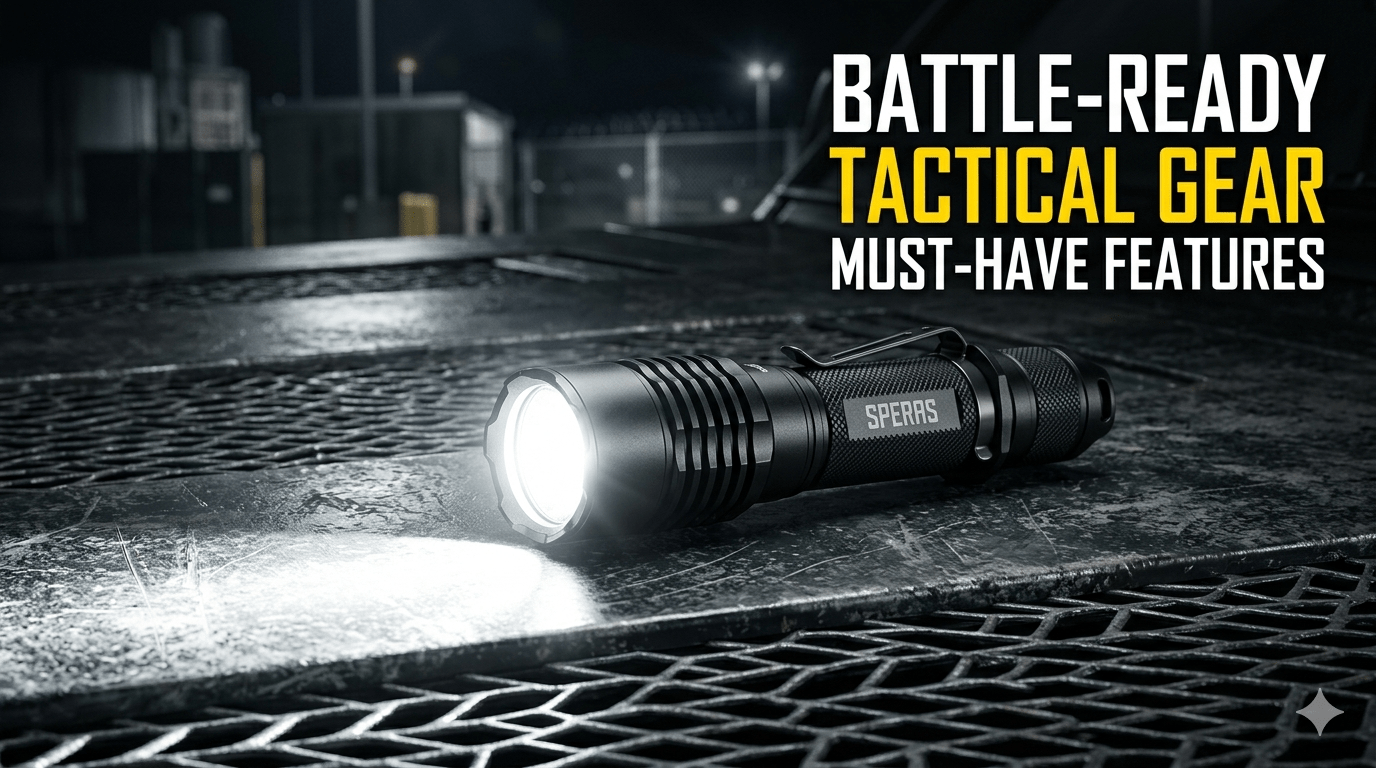
3. Battle-Ready Build Quality (IP68 & Impact Resistance)
The South African environment is unforgiving. Whether it’s a summer downpour in Gauteng or a dusty patrol in the Karoo, your gear must be indestructible.
- IP68 Waterproofing: This isn’t just about “rainproof.” An IP68 rating ensures the light can be submerged in water (typically up to 2 meters) and remain functional.
- Impact Resistance: Tactical lights must be rated for at least a 1.5-meter drop onto concrete. If you drop your light during a scuffle, it must turn back on.
4. Instant-Access Tactical UI
In a confrontation, fine motor skills disappear. You cannot afford to fumble through “Eco,” “Medium,” and “High” modes to find the strobe.
- The Tactical Tail Switch: A non-negotiable feature is a dedicated tail-cap button that allows for “Momentary On” (pressing halfway for a burst of light) and “Instant Strobe.”
- Logical Interface: The user interface should be “mode-memory” capable or have a dedicated toggle so the light always activates at the highest possible output when it matters most.
5. Reliable Power & Rapid Charging
During Stage 6 loadshedding, the “grid” is often down just when security risks are highest.
- USB-C Integrated Charging: Modern units like the Speras EST allow for rapid charging inside a patrol vehicle or via a power bank.
- Dual-Fuel Capability: The best tactical lights can run on high-capacity Li-ion batteries but are also compatible with CR123A disposables as a secondary backup for long-duration deployments.
Product Spotlight: The Speras EST & P4
For those looking to upgrade their duty belt, the Speras EST (1,900 lumens) offers a streamlined, high-performance EDC option for rapid response. For maximum “throw” and power, the Speras P4 (2,500 lumens) remains the gold standard for perimeter guards and specialized units.
Don’t compromise on your primary safety tool.
Invest in lighting that was built for the mission.